Meal prep becomes far less complicated when one kitchen tool can measure ingredients accurately and organize useful nutrition information. Best Smart Kitchen Scales under $100 are especially helpful for portion control, baking, calorie tracking, and repeatable recipes.
We reviewed 5 models from brands including Etekcity, URAMAZ, arboleaf and more and compared the features that affect everyday satisfaction. This guide focuses on accuracy, app usefulness, capacity, cleaning, connectivity, and the compromises hidden behind impressive specifications.
The category has changed because affordable scales now offer barcode databases, recipe tools, fitness-app synchronization, rechargeable batteries, and even assisted food recognition. If you also care about broader household wellness equipment, our guide to comfortable home blood pressure machines offers another practical comparison.


Best Smart Kitchen Scales under $100 Buying Guide
1. Measurement Accuracy and Resolution
Accuracy determines whether your portions and recipes remain consistent, particularly when measuring coffee, yeast, spices, supplements, or small servings. Resolution describes the smallest displayed increment, but a smaller increment does not automatically guarantee better real-world accuracy.
Compare the minimum readable amount, stated tolerance, sensor design, and weighing range rather than focusing only on a marketing claim. URAMAZ emphasizes fine readings, while Fuzion and Ultrean provide broader capacities useful when larger ingredients or containers are involved.
For baking, choose a model that reads at least one gram increments and place it on a stable, level surface. Test repeatability by weighing the same ingredient several times, then use the scale whose readings remain closest together.
2. Nutrition Database and Tracking Tools
A nutrition scale is valuable only when its database and logging process fit the way you eat. Look for calorie, protein, carbohydrate, fat, fiber, sugar, sodium, and micronutrient information instead of relying on calorie totals alone.
Etekcity and arboleaf describe access to very large food databases with numerous nutrient fields, while URAMAZ focuses on USDA foods and subscription-free tracking. Ultrean adds AI food recognition and barcode scanning, although barcode availability can depend on location.
Check whether you can create custom foods, save recipes, edit serving sizes, and correct database entries. Those functions matter more than database size when you regularly cook family recipes or use specialty ingredients.
3. App Compatibility and Connection Reliability
Bluetooth connectivity links the scale with an app, but pairing quality affects whether nutrition tracking feels effortless or frustrating. Before buying, verify support for your phone platform, required permissions, account setup, and whether core weighing remains available without the app.
Apple Health and Fitbit integration can place nutrition records beside exercise information, making trends easier to understand. Android users should pay attention to location permissions because some Bluetooth connections require that setting enabled during pairing.
Choose a conventional display with physical or touch controls if several household members will use the scale. An app should improve organization, not become a mandatory step for measuring flour or checking a container’s weight.
4. Maximum Capacity and Container Clearance
Capacity tells you how much total weight the sensors can support, including the bowl or pan placed on the platform. A scale that handles ordinary ingredients may still struggle with a heavy mixing bowl, large batch, or filled stockpot.
Models in this group range from standard household capacity to options designed for substantially heavier loads. Ultrean and Fuzion are appealing when large recipes matter, while a more compact platform may be easier to store in a crowded kitchen.
Estimate the heaviest container you normally use, then add the ingredient weight and a safety margin. If that combined total approaches the limit, select a higher-capacity model because overload warnings can interrupt recipes and shorten sensor life.
5. Measurement Units and Liquid Modes
Multiple units reduce conversion mistakes when recipes use grams, ounces, pounds, milliliters, or fluid ounces. Liquid modes are convenient, but volume estimates depend on the selected liquid’s density and should not be treated as universal laboratory measurements.
Compare the units available directly on the scale with those available inside the companion app. URAMAZ supports several solid and liquid options, while Fuzion includes an especially broad selection and remembers the last used unit.
Use weight whenever accuracy matters, especially for flour, sugar, coffee, and baking ingredients. Liquid modes are useful for water and milk, but a measuring vessel and careful unit selection still produce the most dependable results.
6. Tare Controls and Everyday Usability
The tare function subtracts the container so you can add ingredients sequentially without dirtying another bowl. A responsive tare control saves time during meal preparation and makes multi-ingredient recipes easier to follow.
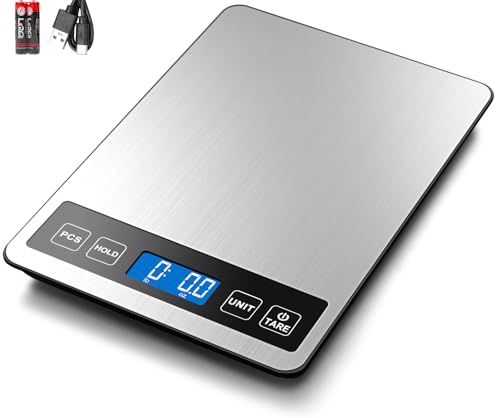
Check whether tare, unit switching, and power controls are easy to locate when the platform is covered. A large backlit display helps when bowls block the screen or when kitchen lighting changes throughout the day.
For repeated recipes, add one ingredient, tare, and wait for the reading to settle before continuing. If you frequently count small items, Fuzion’s PCS function may be more useful than a scale offering nutrition features you rarely open.
7. Platform Materials and Cleaning
Kitchen scales encounter flour, oil, sauces, moisture, and fingerprints, so the platform should be smooth, durable, and simple to wipe. Stainless steel and tempered glass surfaces generally avoid the fabric seams or deep grooves that trap food.
Etekcity uses a food-grade stainless steel platform, while Fuzion combines glass and stainless steel in a larger surface. Arboleaf emphasizes a sleek glass design, which can look attractive but still requires prompt cleaning around touch controls.
Never submerge the scale unless its instructions specifically allow it, and avoid pouring liquid directly over the display. Wipe spills immediately, remove the container before cleaning, and inspect the platform edges where residue commonly collects.
8. Power, Charging, and Automatic Shutoff
Power design affects whether the scale is ready when you need it and whether disposable batteries become an ongoing nuisance. Rechargeable models reduce battery waste, while dual-power designs provide a useful backup during busy cooking sessions.
Arboleaf and Ultrean emphasize rechargeable operation, and Fuzion offers a built-in battery alongside AAA battery support. Compare charging connector type, expected operating habits, low-battery indicators, and how quickly automatic shutoff activates.
A short shutoff preserves energy but can interrupt slow recipe preparation. If you weigh ingredients gradually, favor a model with a practical timeout or a hold function, and keep its charging cable in the same drawer.
9. Display, Size, and Storage
A readable display matters when ingredients, bowls, or your own hands partially block the viewing angle. Consider backlighting, digit size, touch sensitivity, and whether the screen remains legible under bright overhead lighting.
Measure your available storage space before choosing a platform, particularly if you keep the scale in a drawer. A larger surface supports broad bowls more comfortably, while a compact footprint is easier to store and retrieve every day.
Scales with hanging hooks or slim profiles offer additional storage flexibility. Choose the format that matches your routine, because a highly capable scale is less useful when retrieving it feels inconvenient.
10. Warranty and Long-Term Support
Warranty coverage provides reassurance when sensors, charging systems, displays, or Bluetooth features stop working. Read the warranty period, exclusions, return process, and support contact method rather than assuming every brand offers identical protection.
Fuzion specifically highlights a two-year warranty, while Arboleaf describes customer support through the Amazon message center. App support also matters because a nutrition database or synchronization feature can become less useful after software changes.
Save the manual, charging information, and purchase documentation after delivery. If nutrition tracking is central to your decision, favor a brand with clearly explained app support and a practical way to report database problems.
| Priority | What to compare | Useful choice rule |
|---|---|---|
| Nutrition tracking | Database, nutrients, recipes, synchronization | Choose editable entries and no required recurring fee |
| Baking | Resolution, repeatability, tare response | Prefer stable one-gram readings and a clear display |
| Large batches | Capacity and platform size | Add container weight before comparing maximum limits |
| Daily convenience | Charging, cleaning, storage, controls | Prioritize features you will use every meal |
Shoppers who want a simple decision can begin with their main use case, then eliminate models that miss a nonnegotiable requirement. Our comparison of electric bikes for adults uses the same principle by separating essential specifications from attractive extras.
Why You Should Trust Us
We built this comparison from the supplied product specifications, stated features, measurement ranges, app capabilities, power systems, materials, and warranty information. We also considered how each feature affects common tasks such as baking, portion control, meal prep, and nutrition logging.
Products were shortlisted across different use cases rather than ranked by a single headline specification. A nutrition-focused scale needs a different evaluation from a high-capacity kitchen model, so our recommendations explain the trade-offs instead of treating every shopper alike.
We do not claim physical testing where the available data does not support it. Features, availability, app behavior, and product information can change, so readers should confirm current details before ordering and should treat this guide as a transparent comparison of documented capabilities.
Final Thoughts
Our best overall choice is Etekcity Food Kitchen Scale with Nutritional because it balances nutrition depth, a food-grade stainless steel platform, practical tare controls, and broad app connectivity. It suits cooks who want detailed intake tracking without giving up straightforward kitchen weighing.
For value, consider URAMAZ Smart Food Scale with Nutritional. Its subscription-free app, large USDA database, fitness synchronization, liquid modes, and fine measurement capability create a strong feature set for meal planning and diet-focused households.
For specific use, Fuzion Food Scale, 22lb/0.1oz Digital Kitchen stands out for high capacity, seven units, PCS counting, a large platform, dual power, and a stated two-year warranty. It is particularly sensible for bakers, larger batches, brewing, and anyone who values non-app versatility.
Arboleaf and Ultrean remain compelling alternatives when app-based nutrition tools, rechargeable operation, or broader weighing capacity matter most. For more practical household buying advice, visit our Home and Living category for related guides.
FAQs
Are Best Smart Kitchen Scales under $100 accurate enough for baking?
Yes, the reviewed models offer specifications suitable for everyday baking, cooking, and portion measurement. Place the scale on a firm surface, use the tare function, and allow readings to settle before adding ingredients.
Do smart kitchen scales work without an app?
Most scales still provide ordinary weight measurements through their built-in display and controls. The app is mainly useful for nutrition databases, recipes, reports, barcode tools, and synchronization with health platforms.
Can a smart scale measure liquids?
Several models provide milliliter or fluid-ounce modes for water and milk. These modes are convenient estimates based on density, so weighing liquids remains preferable when a recipe requires maximum precision.
What should I weigh before using the maximum capacity?
Include the container, ingredient, and any additional items resting on the platform. Leaving a safety margin below the stated maximum helps avoid overload warnings and reduces unnecessary stress on the sensors.
Do these scales track protein and carbohydrates?
Nutrition-focused models can track protein, carbohydrates, fat, calories, and additional nutrients through their companion applications. The exact information depends on the selected database entry and whether you customize the food correctly.
Does barcode scanning work everywhere?
Barcode availability can vary by country, database coverage, and application support. If scanning is important, confirm regional compatibility and make sure the app also allows manual searches or custom food entries.
How do I clean a digital kitchen scale safely?
Remove the bowl, turn the scale off, and wipe the platform with a slightly damp cloth. Avoid submerging the unit or allowing liquid to enter the display, buttons, charging port, or seams.
Are rechargeable kitchen scales better than battery models?
Rechargeable designs reduce disposable battery use and can be convenient for frequent cooks. Dual-power models offer extra flexibility, especially when the battery is empty and you need to finish a recipe.
What is the top-rated option among Best Smart Kitchen Scales under $100 in 2026?
The strongest documented all-around option is Etekcity Food Kitchen Scale with Nutritional because it combines detailed nutrition tracking with a durable, easy-clean weighing platform. Your ideal choice may differ if high capacity or rechargeable operation is more important.
Can these scales help with weight-loss meal planning?
They can make portions more consistent and simplify calorie or macro records when paired with a compatible application. A scale supports planning, but it does not replace personalized medical or dietary advice.