Outdoor photographers, action shooters, and frequent travelers need storage that can handle more than ordinary desk-side use. A card may face drops, vibration, moisture, temperature changes, crowded camera bags, and repeated high-speed recording during its working life.
We compared 7 options across rugged construction, transfer performance, video ratings, capacities, compatibility, and stated environmental protection. This guide to Best Shockproof SD Cards helps you separate genuinely useful durability features from impressive specifications that your camera may not support.
Shopping conditions also change as cameras produce larger files and faster burst sequences, making sustained write performance more important than a headline read speed. For another practical perspective on dependable gear for active lifestyles, see our guide to luggage for international travel.



Best Shockproof SD Cards Buying Guide
1. Shockproof and Rugged Construction
Shock resistance matters because memory cards are small, easy to drop, and often carried alongside keys or other equipment. A rugged design can reduce the chance that impact, pressure, or rough handling turns a successful shoot into a lost-file recovery problem.
Read the manufacturer description carefully rather than assuming every SD card offers the same protection. Look for explicit references to shock resistance, temperature tolerance, waterproofing, dustproofing, or a reinforced body, and distinguish card protection from protection provided only by a storage case.
Sony TOUGH-G series SDXC UHS-II Card 128GB, V90 uses one-piece molded construction and removes the usual ribs and write-protection switch. ProMaster rugged cards also emphasize protection for demanding environments, while SanDisk Extreme models are described as shock-proof and suitable for harsh conditions.
2. Write Speed for Burst Photos and Video
Write speed determines how quickly a card accepts data from your camera, so it directly affects burst shooting and demanding video recording. A fast read speed helps afterward, but it cannot compensate for a card that clears the camera buffer slowly.
Compare the stated maximum write speed with the camera’s interface and recording requirements. Sony TOUGH-G lists writing performance up to 299MB/s, while ProMaster’s UHS-II V60 card lists up to 190MB/s, creating a meaningful advantage for compatible professional equipment.
Maximum figures usually require compatible hardware and ideal conditions, so treat them as a ceiling rather than a guarantee. If your camera records long 4K clips or rapid RAW bursts, prioritize the sustained speed class and verified write capability over an attractive read-speed headline.
3. Speed Class and Video Certification
Speed-class markings provide a more useful baseline for video than a single peak transfer number. U3 indicates a minimum sustained write target associated with demanding recording, while V30 and V60 identify video speed classes with different sustained performance levels.
The SANDISK 64GB Extreme PRO SDXC UHS-I Memory Card and SANDISK 256GB Extreme PRO SD Memory Card carry U3 and V30 markings. ProMaster SDXC 128GB Rugged UHS-II V60 Memory carries the higher V60 designation, which better suits cameras requiring stronger sustained throughput.
Always check your camera manual before choosing a class, because resolution, frame rate, codec, and bit rate change the requirement. As a simple rule, select the camera’s stated minimum class first, then choose additional headroom if you record lengthy clips or work in warm conditions.
4. Card Type and Camera Compatibility
SDHC and SDXC describe capacity ranges and file-system expectations, while UHS-I and UHS-II describe the bus interface. A card can physically fit your camera yet operate below its advertised performance if the device supports only an older standard.
Check the camera’s supported capacity, interface, speed class, and recommended file system before purchasing. UHS-II cards include an additional row of contacts and may work in UHS-I equipment, but their headline performance requires a compatible UHS-II host.
Backward compatibility is useful when one card moves between newer and older cameras, although the slower device becomes the limiting factor. This matters especially for households sharing cards between cameras, laptops, card readers, and camcorders.
| Feature | What to check | Why it matters |
|---|---|---|
| UHS-I | Host support and practical write speed | Works with many mainstream cameras |
| UHS-II | Second contact row and compatible reader | Enables faster transfers and recording |
| V30 | Sustained video rating | Useful baseline for many 4K workflows |
| V60 | Camera requirement and sustained workload | Provides more video-writing headroom |
5. Storage Capacity and File Management
Capacity should match your shooting habits, not simply the largest number available. Larger cards reduce card changes during travel, but they can also concentrate more files in one place if the card fails or becomes misplaced.
Estimate your typical file size and shooting duration before deciding. A 128GB card offers substantially more working room than a 32GB card, while 256GB becomes attractive for long 4K sessions, high-resolution RAW files, or trips without reliable access to a computer.
Many photographers prefer several moderate-capacity cards rather than one enormous card, especially when assignments cannot be repeated. Whatever capacity you select, create a transfer routine and avoid filling the card completely because cameras and file systems need operational space.
6. Read Speed and Transfer Workflow
Read speed controls how quickly photographs and video move from the card to a computer or external drive. Faster transfers shorten breaks between shoots and make large batches easier to back up before traveling onward.
SanDisk lists read performance up to 200MB/s on its Extreme PRO cards, while Sony TOUGH-G lists up to 300MB/s and ProMaster UHS-II lists up to 290MB/s. These results depend on a compatible reader, interface, cable, computer, and the card’s actual workload.
If transfer speed is central to your workflow, budget for a reader that matches the card’s bus standard. A UHS-II card connected through a basic UHS-I reader cannot deliver its full potential, making the accessory part of the performance decision.
7. Waterproofing, Dustproofing, and Temperature Range
Environmental protection is valuable when your camera leaves a controlled indoor space. Moisture, dust, freezing conditions, and hot vehicles can affect both the card and the camera, particularly during extended outdoor assignments.
ProMaster SDXC 128GB Rugged UHS-II V60 Memory specifies IP68 ingress protection and an operating range from -13°F to 185°F. Sony TOUGH-G also lists IPX8 waterproofing, IP6X dustproofing, and the same broad stated temperature range.
These ratings describe the card under stated test conditions, not an invitation to expose your entire camera system unnecessarily. Keep cards dry before inserting them, use a protective case, and allow equipment to acclimate when moving between extreme temperatures.
8. Warranty, Replacement Support, and Reliability
A warranty cannot recover irreplaceable images, but it reveals how the manufacturer stands behind the product. Look for clearly stated coverage, replacement procedures, regional limitations, and any exclusions related to misuse or physical damage.
ProMaster SDXC 128GB Rugged UHS-II V60 Memory includes a limited lifetime warranty and a 48-hour replacement guarantee under its stated program. SanDisk also identifies a lifetime limited manufacturer warranty for the SANDISK 128GB Extreme SDXC UHS-I Memory Card, subject to regional terms.
Keep purchase records and register eligible products when the manufacturer recommends it. For important work, reliability also comes from redundancy: back up files promptly and never treat one memory card as the only copy of an assignment.
9. Real-World Value and Accessories
Value depends on how much performance and protection your camera can use, rather than the card with the most impressive specification. A high-end UHS-II card may be unnecessary for a basic camera that records modest bit rates through a UHS-I interface.
Compare the complete workflow, including a compatible reader, protective case, backup drive, and the time saved during transfers. A lower-capacity card may be the sensible choice for occasional photography, while professionals may justify faster media because downtime has a larger cost.
For broader buying habits involving dependable equipment, our auto battery brand guide also emphasizes warranty clarity, compatibility, and practical reliability rather than specifications alone.
Why You Should Trust Us
We built this comparison from the supplied product specifications, stated durability features, interface standards, speed classes, capacities, warranty information, and listed use cases. We separated peak read and write claims from sustained video classifications so the comparison reflects how cards perform in different workflows.
Our shortlist includes products from Sandisk, Sony, and ProMaster across UHS-I and UHS-II designs, compact capacities, and larger options for serious recording. We did not claim physical testing, laboratory benchmarking, or independent drop testing where the available product data did not support those conclusions.
Because availability and specifications can change, we encourage readers to confirm the current camera compatibility and manufacturer warranty before ordering. The comparison remains useful by focusing on durable decision criteria that apply beyond a single retailer listing or temporary promotion.
Final Thoughts
Our best overall recommendation is Sony TOUGH-G series SDXC UHS-II Card 128GB, V90 for compatible professional cameras. Its one-piece molded construction, ribless body, waterproof and dustproof design, V90 rating, and very high stated transfer performance create a strong combination for demanding photography.
For value, consider SANDISK 64GB Extreme PRO SDXC UHS-I Memory Card when your camera uses UHS-I and your projects fit a smaller capacity. Its U3 and V30 markings, 4K suitability, harsh-condition protection, and useful transfer performance make it a balanced everyday option.
For long video sessions and users wanting stronger sustained performance, ProMaster SDXC 128GB Rugged UHS-II V60 Memory is the specific-use pick. IP68 protection, V60 certification, UHS-II capability, broad temperature tolerance, and warranty support suit active shooting environments.
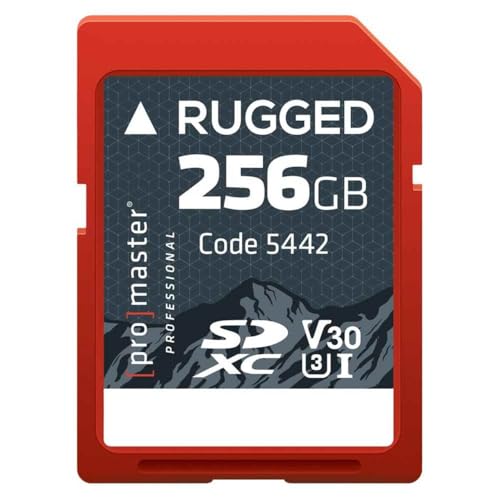
Travel photographers needing extra space can also consider ProMaster SDXC 256GB Rugged™ Memory Card UHS-I, while the SanDisk Extreme options fit users who value familiar compatibility and 4K-oriented speed classes. Pair any choice with a reliable reader and an immediate backup routine.
If your wider purchase involves travel organization, our guide to luggage for international travel offers another equipment-planning resource. Buyers comparing categories can also browse the Uncategorized product guides for additional practical reviews.
FAQs
What makes an SD card shockproof?
A shockproof SD card uses construction and materials intended to resist impact, bending, vibration, or rough handling. Protection varies by model, so confirm the manufacturer’s specific claims instead of relying on the word rugged alone.
Are shockproof SD cards also waterproof?
Some rugged cards include waterproofing, but shock resistance and water resistance are separate features. Sony TOUGH-G and ProMaster UHS-II list explicit water and dust protection, while every model should still be handled carefully around moisture.
Is UHS-II better than UHS-I for every camera?
UHS-II is faster when the camera and reader support its additional contacts and interface. In a UHS-I camera, a UHS-II card may function, but it generally cannot deliver the full advertised UHS-II performance.
Can a V30 card record 4K video?
Many cameras can record 4K successfully with a V30 card, especially at moderate bit rates and frame rates. Check the camera manual because codecs, resolution settings, and recording modes can create higher requirements.
How much capacity should a photographer choose?
Choose capacity according to file size, shooting duration, and how often you can transfer files. A 32GB card suits lighter use, while 128GB or 256GB provides more flexibility for RAW photography, extended video, and travel.
Does a faster read speed improve camera shooting?
Read speed mainly improves transfers after shooting and does not automatically increase camera write performance. For burst photography and video, examine the write speed and sustained video rating first.
What is the top-rated option among Best Shockproof SD Cards in 2026?
Sony TOUGH-G series SDXC UHS-II Card 128GB, V90 stands out for its stated construction, environmental protection, and high performance. It is most compelling when your camera supports UHS-II and your work benefits from fast sustained recording.
Do I need a special card reader for UHS-II?
A UHS-II reader is needed to approach the fastest transfer speeds from a UHS-II card. A UHS-I reader can still read compatible media, but the connection becomes the bottleneck.
Should video creators choose V60 instead of V30?
Choose V60 when your camera requires it or when high-bitrate recording benefits from additional sustained write headroom. V30 remains appropriate for many 4K workflows, so paying for V60 only makes sense when the device and recording format can use it.
How can I protect photos stored on an SD card?
Copy files to at least one separate device as soon as practical, then verify that the backup opens correctly. Avoid deleting the original card until the backup is confirmed and ideally duplicated in another location.