A dependable charger helps you spend more time riding and less time waiting beside an outlet. For riders replacing a lost charger, keeping a second charger at work, or preparing a touring setup, compatibility matters more than a familiar brand name.
Our comparison of 10 Best Ebike Battery Chargers focuses on output voltage, battery chemistry, connector choices, protection systems, and everyday convenience. The category has added more multi-tip options and certified safety designs, but those features do not make every charger universal.
We explain the specifications that can prevent a costly mismatch, including why a 48V lithium battery normally needs a 54.6V charger. If you are also choosing an ebike, our guide to electric bikes for adults provides useful context for matching equipment to your riding routine.






Best Ebike Battery Chargers Buying Guide
1. Match the Battery Voltage and Chemistry
Voltage is the first specification to verify because a charger must match the battery system, not merely the bicycle’s model name. Most products in this comparison are designed for 48V lithium-ion or 13S lithium batteries.
A 48V lithium-ion pack typically reaches full charge at 54.6V, so a charger labeled 54.6V is usually the correct pairing. That does not make it suitable for 36V, 52V, lead-acid, or LiFePO4 batteries.
Read the battery label and the original charger before ordering. If the original output says 54.6V and the replacement identifies 48V lithium-ion compatibility, the electrical match is promising, but connector polarity still requires confirmation.
2. Compare Charging Current With Your Routine
Charging current affects how quickly a depleted battery can return to service. The reviewed choices mainly use 2A outputs, while the UL Certified 54.6V 3A Faster ebike Charger for 48V provides a higher-current alternative for compatible 48V packs.
As a rough estimate, divide battery capacity in amp-hours by charger current, then allow additional time for the final charging stage. A 15Ah battery with a 3A charger may need roughly five hours under ideal conditions, while a 2A charger takes longer.
More current is not automatically better because the battery manufacturer sets acceptable charging limits. Choose 3A when the battery supports it and downtime matters, but choose 2A when conservative charging, broad compatibility, or a lower thermal load is more important.
3. Verify the Connector, Polarity, and Pinout
Physical fit is only one part of charger compatibility. A plug can enter the port while having the wrong polarity or pin arrangement, creating a serious risk for the battery and charger.
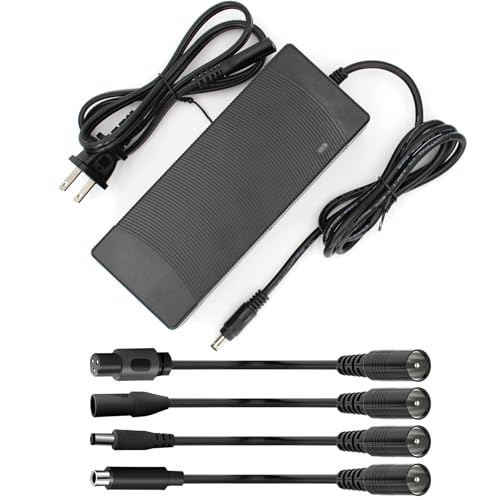
Measure the barrel connector when possible, then compare the positive and negative contacts with the original charger. Multi-tip models such as the QKIIP 54.6V 2A Charger for 48V Ebike Scooter include several common adapters, but included tips still need careful matching.
Before ordering, photograph the original plug beside a ruler and inspect the product’s connector diagram. A connector count is useful for flexibility, yet the correct diameter, polarity, and pinout matter more than having the largest adapter assortment.
4. Consider Adapter Coverage and Brand Compatibility
Riders with common ebike platforms may benefit from a replacement charger that lists their exact model family. The 54.6V 2A Charger for 48V Lithium-ion ebike includes seven connectors and identifies compatibility with many Lectric, Rad Power, Ride1Up, Aventon, and other platforms.
Brand lists should be treated as a starting point rather than a guarantee. Manufacturers can change ports between model years, and two bikes carrying the same voltage label may use different charging sockets or battery management systems.
Check the model year, battery label, and original charger output together. If you own several devices, a multi-connector design may reduce the need for separate chargers, but it should never override the electrical checks described above.
5. Prioritize Protection and Certification Claims
Protection circuits help respond to abnormal conditions such as overvoltage, overcurrent, short circuits, and excessive temperature. Auto shutoff and regulated charging can also reduce the chance of leaving a full battery connected unnecessarily.
Several options identify UL, SGS, ETL, CE, FCC, or RoHS-related compliance, but these labels should be read carefully. A safety claim is most useful when the product identifies a model, testing standard, or certification detail rather than relying on vague wording.
Look for thermal protection, short-circuit protection, clear status indicators, and a flame-resistant enclosure. Certification does not correct a voltage mismatch, so safety features should reinforce compatibility rather than replace it.
| Specification | What to verify | Why it matters |
|---|---|---|
| Battery system | 48V lithium-ion or 13S | Prevents incompatible charging |
| Output | 54.6V and suitable amperage | Matches full-charge requirements |
| Connector | Size, polarity, and pinout | Ensures electrical and physical fit |
| Protection | Overvoltage, heat, current, and short circuit | Adds safer everyday operation |
6. Evaluate Heat, Noise, and Build Quality
Chargers often operate for several hours, making heat and noise relevant in bedrooms, offices, workshops, and small apartments. A cooler design can be more comfortable to use and may reduce stress on internal components.
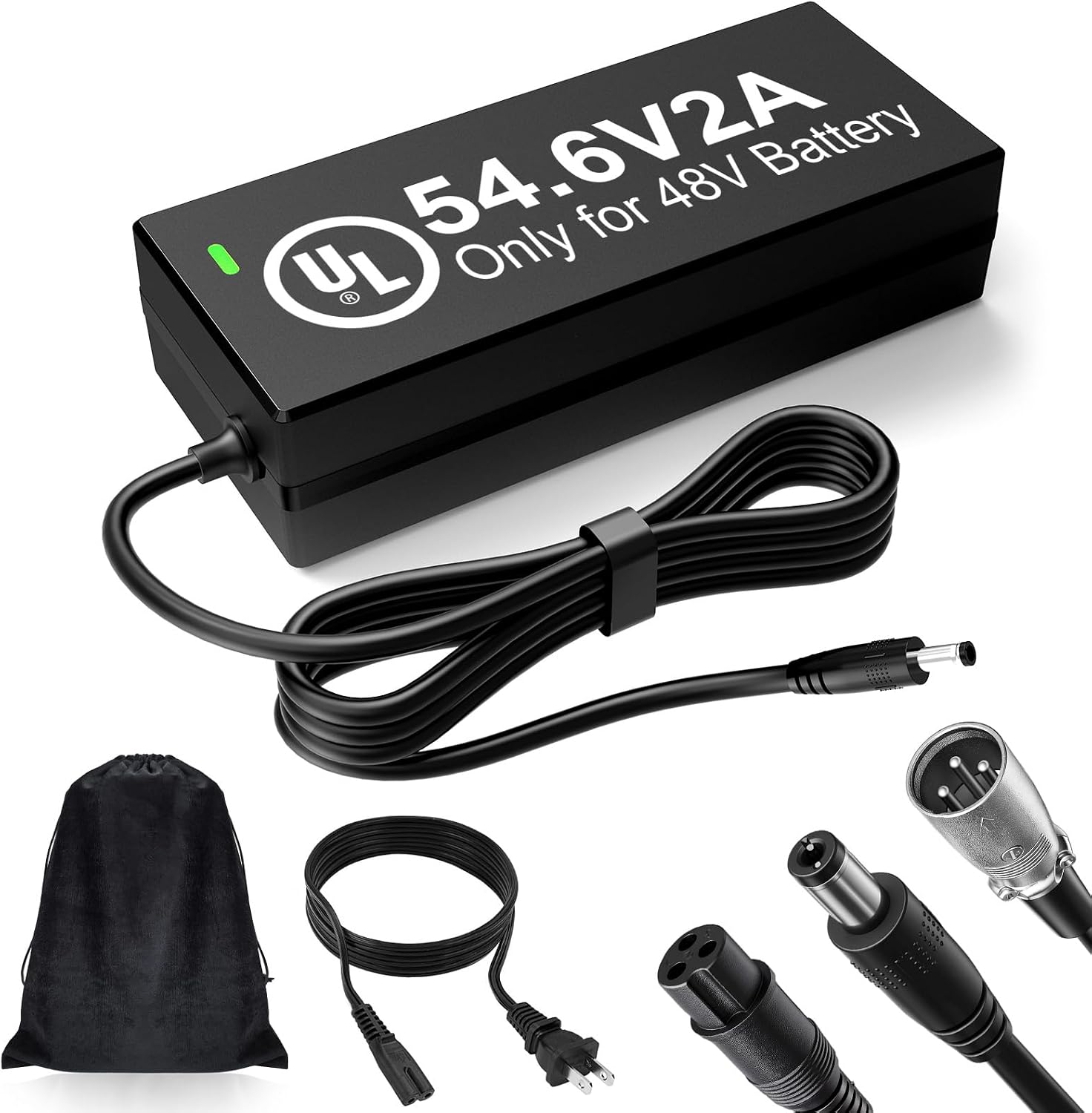
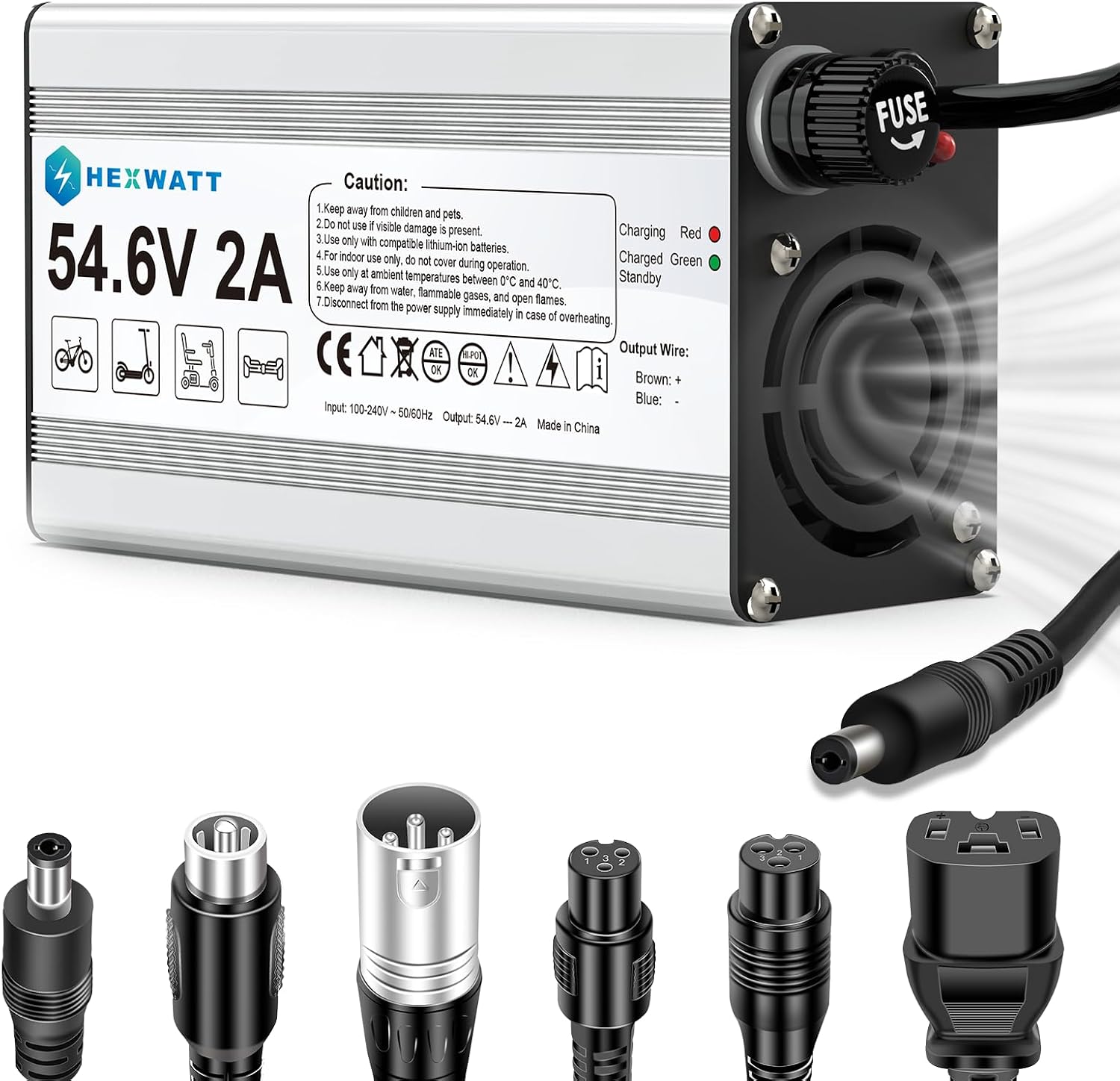
The 48V Lithium Battery Charger uses intelligent temperature control, a fire-resistant case, and a quiet design. Some alternatives use aluminum housings or cooling fans, which can improve heat management but may introduce audible operating noise.
For a quiet home environment, prioritize fanless or low-noise construction when the manufacturer provides credible details. For frequent travel, inspect cable strain relief, connector durability, casing strength, and included storage accessories before choosing.
7. Use the LED Indicator and Shutoff Features Properly
LED indicators make basic charging status easier to understand without opening an app. Across these products, red commonly indicates active charging and green generally means full, disconnected, or ready.
Automatic shutoff or a transition to a low maintenance current can help prevent unnecessary charging after completion. However, no charger should be treated as permission to leave a battery unattended for extended periods.
Place the charger on a hard, ventilated surface and keep it away from moisture, fabric, and direct heat. If the indicator behaves unexpectedly, unplug the unit and recheck the battery, connector, and charger specifications before trying again.
8. Check Input Range and Travel Convenience
A 100V to 240V input range supports use across many household electrical systems and can be helpful for travelers. It does not eliminate the need for a suitable wall plug adapter in every country.
Compact dimensions, a manageable cable, and a storage bag can matter as much as charging speed when the charger travels daily. The 48V Lithium Battery Charger, for example, includes a storage bag, while several alternatives emphasize interchangeable connectors.
Choose based on where charging happens most often. A home backup can favor robust housing and simple operation, while a commuting charger benefits from lower weight, connector versatility, and protection against cable wear.
9. Compare Warranty, Support, and Return Practicality
Charger specifications cannot reveal every detail about long-term support, so warranty terms and seller responsiveness deserve attention. A clear return process is especially useful when a bike has an unusual connector or a model-year variation.
Some listings offer a stated warranty or invite buyers to send a photograph of the original charger for compatibility confirmation. That support can reduce guesswork, though you should still retain the original label and document your battery specifications.
Save the product page, receipt, and compatibility notes after purchase. For broader vehicle equipment research, our comparison of reliable auto battery brands also illustrates why fit and support should be evaluated together.
10. Balance Price, Features, and Actual Need
The least expensive charger may be perfectly suitable when it matches the battery, includes the needed connector, and provides credible protection. Paying more becomes worthwhile when you need faster charging, broader adapter coverage, certification details, or a more durable enclosure.
A useful decision rule is to rank requirements before comparing extras. First require the correct voltage and chemistry, then confirm connector compatibility, followed by charging current, protection, noise, and portability.
Do not select a charger because it lists the greatest number of brands or plugs. The best choice is the one that satisfies your battery’s electrical requirements while solving the specific inconvenience that caused you to shop.
Why You Should Trust Us
We compared the supplied product specifications, output ratings, connector counts, compatibility statements, protection features, certification references, indicator behavior, and stated design details. We also considered how each feature changes the decision for home charging, commuting, travel, or backup use.
Our shortlist emphasizes products with clearly stated 54.6V output for compatible 48V lithium-ion batteries, while noting where listings warn against other voltages or battery chemistries. We do not treat brand-name compatibility as conclusive without recommending that readers verify the port and original charger.
Because marketplace specifications and availability can change, this comparison is designed to be refreshed as listing information changes. We do not claim to have physically tested these chargers, and our recommendations are based on the supplied product data rather than undisclosed hands-on results.
Final Thoughts
Our best overall recommendation is the UL Certified 54.6V 3A Faster ebike Charger for 48V because it combines faster 3A charging, intelligent temperature control, auto shutoff, a V0 fire-resistant case, and three connector formats. It is a strong fit for compatible 48V lithium batteries when reduced downtime is the priority.
Our best value choice is the EVAPLUS 54.6V Safe Charger for 48V Lithium. Its 54.6V output, UL certification claim, automatic shutoff, common DC connector sizes, and worldwide input range cover the essentials for many compatible 48V packs.
For broad connector coverage, consider the QKIIP 54.6V 2A Charger for 48V Ebike Scooter. Its seven plug tips can help households with varied equipment, provided you confirm the battery label, original output, connector polarity, and lithium-ion chemistry first.
Riders comparing charging equipment alongside a new bicycle can also consult our electric bike buying guide. Whichever charger you select, verify compatibility before connecting it, and treat safety claims as supporting evidence rather than a substitute for careful specification checks.
FAQs
What is the top-rated option among Best Ebike Battery Chargers in 2026?
The UL Certified 54.6V 3A Faster ebike Charger for 48V stands out for compatible 48V lithium batteries because it combines higher current with temperature control and multiple protections. Confirm that your battery supports 3A charging before choosing it.
Can I use a 54.6V charger on any battery labeled 48V?
Usually, 54.6V corresponds to a 48V 13S lithium-ion battery, but the label alone is not enough. Confirm the battery chemistry, original charger output, connector, polarity, and manufacturer guidance.
Is a 3A ebike charger better than a 2A charger?
A 3A model can reduce charging time when the battery is designed to accept that current. A 2A charger may be preferable when compatibility, lower heat, or conservative charging is more important.
How do I know which charging plug my ebike uses?
Inspect the original charger and measure the plug, then compare its polarity and pin arrangement with the replacement listing. Never assume that a physically similar barrel or aviation connector has the same wiring.
Are universal ebike chargers genuinely universal?
Universal usually means that several common connector tips are included, not that every battery system is supported. Voltage, chemistry, charging voltage, polarity, and pinout still need to match exactly.
Can these chargers charge lead-acid batteries?
No, the products discussed here are specified primarily for compatible 48V lithium-ion batteries. Lead-acid and LiFePO4 batteries use different charging requirements, so use a charger designed for that chemistry.
What does red or green mean on an ebike charger?
Red commonly means charging, while green usually indicates a full battery, standby, or no connected battery. Indicator conventions can vary, so confirm the meaning in the product instructions.
Can I leave an ebike battery charging overnight?
Automatic shutoff improves convenience but does not remove all charging risk. Follow the battery and charger instructions, use a ventilated nonflammable surface, and avoid charging unattended whenever possible.
Why does my replacement charger not start charging?
The battery may have a depleted or damaged management system, the connector may be wrong, or the battery voltage and chemistry may not match. Recheck the original charger label and stop using the replacement if it becomes unusually hot.
Does a faster charger extend battery life?
Charging speed alone does not extend battery life, and excessive current can create additional stress. Temperature control, correct voltage, appropriate current, and avoiding unnecessary full-charge cycles are more important factors.