A black monitor gives a workspace a cohesive appearance, while a capable USB-C connection can reduce cable clutter around laptops, docks, and accessories. The right display should balance sharpness, screen size, refresh performance, connectivity, and comfort rather than relying on color alone.
Our guide to Best Black USB-C Monitors helps you compare 5 KTC displays using the specifications that most affect daily use. USB-C availability and power delivery can vary significantly, so check the port details carefully before assuming every USB-C monitor supports one-cable laptop charging. For broader workspace ideas, see our guide to Furniture & Comfort products.
Resolution, refresh rate, and panel technology have become more competitive, giving shoppers better choices for productivity and casual gaming. This comparison focuses on practical trade-offs, including whether a larger screen, faster refresh rate, sharper QHD image, or smaller footprint makes the most sense for your desk.


Best Black USB-C Monitors Buying Guide
1. Confirm the USB-C Connection
USB-C is a connector shape, not a guarantee of identical capabilities. A monitor may use USB-C for video input, data transfer, charging, or a combination of these functions, so the specification must identify exactly what the port supports.
Look for DisplayPort Alt Mode when you want video from a compatible laptop, and check the stated power delivery wattage if you expect charging. A basic USB-C video connection may still require a separate charger, particularly with performance-oriented notebooks.
Before buying, compare your laptop requirements with the monitor specification and cable rating. If the display lacks USB-C video or meaningful power delivery, a USB-C dock can restore one-cable convenience, but it adds cost and another device.
2. Match Screen Size to Viewing Distance
Screen size changes how comfortably you can arrange windows, read text, and enjoy movies or games. A 24-inch display suits compact desks, while 27-inch models usually provide a strong balance between workspace and viewing comfort.
A 32-inch monitor creates a more immersive image and leaves room for multiple documents, timelines, or large spreadsheets. However, it needs more desk depth and may require greater head movement when viewed from a short distance.
Measure the available width, depth, and monitor height before choosing. As a practical starting point, place the screen roughly an arm’s length away and keep the top edge near eye level to reduce neck strain.
3. Choose the Right Resolution
QHD or 1440p resolution provides considerably more workspace and detail than 1080p at similar screen sizes. Text appears cleaner, images show finer detail, and two windows can remain usable without feeling excessively cramped.
The reviewed KTC models use QHD resolutions, including 2560 by 1440 panels. On a 27-inch screen, that resolution produces a sharp pixel density, while a 32-inch panel offers a larger image with slightly less density.
Consider your computer’s graphics capability as well as your work. QHD gaming requires more graphics performance than 1080p, although office software benefits from the extra workspace even when gaming is not a priority.
4. Compare Refresh Rate and Adaptive Sync
Refresh rate describes how often the monitor updates its image each second. Higher rates make cursor movement, scrolling, and games appear smoother, with 100Hz, 120Hz, and 144Hz offering a noticeable improvement over conventional 60Hz displays.
Adaptive sync helps the monitor coordinate with a compatible graphics processor when frame rates fluctuate. FreeSync or G-Sync compatibility can reduce tearing and stuttering, especially when a game cannot maintain a perfectly consistent frame rate.
Choose 100Hz or 120Hz for comfortable general use and casual gaming, then consider 144Hz when fast games matter more. Remember that the computer must produce enough frames to make the higher refresh rate meaningful.
5. Evaluate Panel Technology and Contrast
Panel technology influences contrast, viewing angles, color behavior, and motion response. IPS panels are widely valued for consistent colors and broad viewing angles, while HVA-style panels can provide deeper contrast and darker-looking scenes.
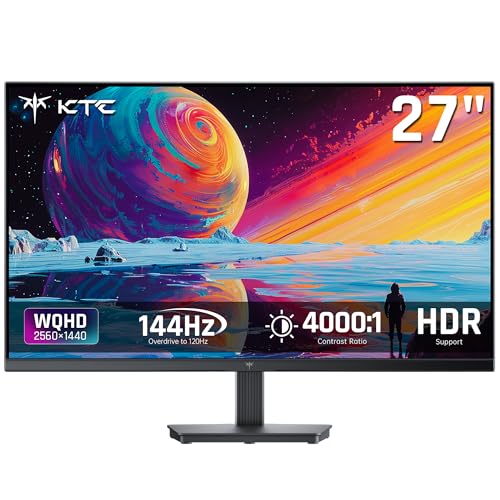
The KTC 27 Inch QHD Computer Monitor lists a 4000:1 contrast ratio, which can benefit movies and dark games. Several other models use IPS panels, emphasizing color consistency, viewing flexibility, and a balanced experience for office work.
Do not judge a panel from contrast alone. If multiple people view the display or your work depends on predictable colors, viewing angles and calibration may matter more than deeper blacks.
6. Check Color Coverage and HDR Support
Color gamut indicates the range of colors a display can reproduce, while brightness and contrast affect how convincing those colors appear. Wider coverage can make photographs, games, and video look more vivid, although oversaturated output may not suit every workflow.
Several reviewed monitors list broad sRGB coverage, HDR10 support, and brightness figures intended to improve visual impact. HDR support is useful only when the display, software, connection, and content all cooperate, so treat the label as one factor rather than a complete quality guarantee.
For routine office work, accurate sRGB behavior is usually more valuable than maximum gamut. Creative users should prioritize a documented color mode, consistent calibration, and the ability to adjust brightness without losing comfortable readability.
7. Review Available Ports and Cable Planning
Ports determine how easily you can connect a laptop, desktop, console, streaming device, or second computer. HDMI is broadly compatible, while DisplayPort is especially common on desktop computers and supports many high-refresh configurations.
The reviewed displays provide combinations of HDMI and DisplayPort, with some specifications listing multiple HDMI inputs. More inputs make switching devices easier, but they do not automatically provide USB-C video or laptop charging.
Make a simple connection list before purchasing: identify every source, required resolution, target refresh rate, and cable type. This prevents a monitor from becoming a bottleneck when your computer supports features that an older cable cannot carry.
| Priority | Specification to check | Practical choice |
|---|---|---|
| Office work | QHD resolution and eye comfort | 27-inch IPS with 120Hz |
| Immersive viewing | Screen size and contrast | 32-inch panel with HDR support |
| Fast gaming | Refresh rate and adaptive sync | 144Hz with compatible sync |
| Small desk | Width and pixel density | 24-inch QHD display |
8. Consider Ergonomics and Mounting
A monitor that looks excellent can still disappoint if its stand places the screen too low or forces an awkward viewing angle. Tilt adjustment helps aim the panel, while a VESA mounting pattern can provide better height and distance control.
Several KTC specifications mention tilt adjustment or 100 by 100 millimeter VESA compatibility. Confirm whether the stand offers only tilt or also height, swivel, and pivot movement, because these features are not interchangeable.
For long work sessions, prioritize the position you can maintain comfortably. A monitor arm may be worthwhile when desk space is limited, but verify the display’s weight, mounting pattern, and arm capacity first.
9. Protect Your Eyes During Long Sessions
Flicker-free operation and blue-light reduction can make extended viewing more comfortable, particularly in offices, study areas, and gaming rooms. These features do not eliminate fatigue caused by glare, poor posture, or staring without breaks.
The reviewed KTC displays commonly list anti-flicker and anti-blue-light technologies. Compare those features with brightness controls, matte screen treatment, and your room lighting, since comfort depends on the complete setup.
Keep brightness close to the room’s apparent light level and use the 20-20-20 habit during long sessions. Every 20 minutes, look approximately 20 feet away for 20 seconds to relax your focusing muscles.
10. Weigh Warranty and Support
Warranty coverage matters because a monitor is commonly used for many hours each week. A clear warranty period and responsive support can reduce disruption if the panel develops a fault or an input behaves unexpectedly.
Several KTC listings describe a three-year warranty and customer support, but you should still read the current terms before ordering. Check what is covered, how returns work, and whether dead-pixel policies are separate from standard defects.
Keep the purchase record, packaging information, and model number after delivery. Test every input, inspect the panel, and confirm the advertised refresh rate during the return period rather than waiting until later.
Why You Should Trust Us
We compared the listed KTC monitors using published specifications, including resolution, panel type, refresh rate, contrast, color coverage, ports, ergonomic details, and eye-comfort features. We also considered how each specification changes practical use instead of treating every feature as equally important.
Our shortlist reflects different desk sizes and priorities, from compact QHD viewing to larger immersive screens and faster gaming refresh rates. We did not claim hands-on testing where the supplied product data did not support that conclusion.
Because availability and specifications can change, we recommend checking the current product listing before purchase. Our comparison stays transparent by separating documented features from reasonable buying guidance, allowing you to verify the details that matter most.
Final Thoughts
For a large, immersive workspace, our best overall recommendation is KTC 32 Inch Monitor 2K Monitor. Its 32-inch QHD IPS panel, 120Hz refresh rate, HDR10 support, thin bezels, and multiple video inputs create a versatile option for work, movies, and casual gaming.
The best value choice is KTC 27 Inch Computer Monitor. It combines QHD resolution, IPS viewing, 120Hz performance, adaptive sync, HDR10, broad color coverage, and comfort features in a compact format suited to everyday productivity.
For fast gaming and strong dark-scene contrast, consider KTC 27 Inch QHD Computer Monitor. Its 144Hz refresh rate and listed 4000:1 contrast ratio make it a compelling fit when responsive motion and deeper-looking blacks matter most.
Small desks may favor KTC 24 Inch QHD 100Hz Computer Monitor, while the larger KTC 32 Inch 2K Computer Monitor suits users wanting IPS viewing, 120Hz motion, and a roomier image. For more household buying guidance, explore Home & Living reviews.
FAQs About Best Black USB-C Monitors
Are black monitors better for a workspace?
Black monitors are not automatically better, but their neutral finish works well with many desks and accessories. Choose based on display performance first, then use the color to match your preferred setup.
Does every USB-C monitor charge a laptop?
No. USB-C may carry video without providing meaningful power delivery, so confirm the listed wattage and charging support before expecting one-cable operation.
Is QHD worthwhile on a 24-inch monitor?
QHD can make text and graphics especially sharp on a 24-inch display. You may need operating-system scaling, but the extra detail can benefit reading and multitasking.
Is 120Hz useful outside gaming?
Yes. Higher refresh rates make scrolling, window movement, and pointer motion feel smoother, even when you mainly use office software.
What is the top-rated option among Best Black USB-C Monitors in 2026?
The supplied data identifies several strong KTC options, with the larger IPS models offering particularly broad use cases. Your best choice depends on whether size, contrast, refresh rate, or desk space has priority.
Can a monitor replace a USB-C docking station?
Only when it includes the necessary USB-C video, power delivery, and accessory connectivity. A display with video-only USB-C will not provide the complete functionality of a dock.
Are IPS panels suitable for casual gaming?
Yes. IPS panels commonly provide attractive colors and wide viewing angles, while refresh rate and adaptive sync determine much of the gaming smoothness.
What cable should I use for QHD at high refresh rates?
Use a cable rated for the monitor’s resolution and refresh target, following the input specification. DisplayPort or a suitable HDMI standard may be required depending on the source device.
Does HDR10 guarantee excellent HDR?
No. HDR10 compatibility identifies a supported format, but brightness, contrast, local dimming, and content quality determine the visible result.
What size monitor is easiest for a small desk?
A 24-inch display usually leaves more room for speakers and accessories while still providing useful QHD workspace. Measure depth as carefully as width because a large stand can consume valuable space.