Fresh paint, new furniture, flooring adhesives, and strong cleaning products can leave indoor spaces smelling unpleasant for days. The right purifier may help reduce those odors, but only when its filtration method matches the pollutants involved.
We compared 5 models from BLUEAIR, Puraclenz, DREO using their published filtration systems, sensing features, room coverage claims, operating modes, and maintenance details. This guide helps you avoid a common mistake: choosing a particle-focused purifier when chemical odors require meaningful activated carbon or another odor-targeting technology.
For broader home comfort advice, our Heating, Cooling & Air category includes additional equipment guides. Use the comparison below as a starting point, then match the purifier to your room, odor source, and ventilation routine.




How to Choose Best Air Purifiers for Chemical Odors
1. Activated Carbon and Odor-Fighting Media
Many chemical odors are associated with volatile organic compounds, commonly called VOCs, rather than only airborne dust. Activated carbon can adsorb some gases and odor molecules, making carbon quantity and design more important than a HEPA label alone.
Read the filter description carefully and look for an activated carbon layer, carbon pellets, or another specifically identified gas-adsorption medium. A thin carbon-coated sheet may provide less odor capacity than a deeper carbon bed, although manufacturers do not always publish the exact carbon weight.
For persistent odors, prioritize the model with the clearest gas-focused specifications and the largest practical filter assembly. Remember that carbon eventually becomes saturated, so a purifier cannot replace source removal, fresh-air ventilation, or correcting a leak.
2. The Difference Between Particle and Gas Filtration
HEPA and high-efficiency filters are excellent for many particles, including dust, smoke particles, pollen, and some mold particles. They do not automatically remove every gaseous chemical responsible for a solvent, plastic, or fragrance smell.
Compare each product as a system instead of assuming one filter technology solves every indoor-air problem. The DREO models combine a pre-filter, high-efficiency filter, and activated carbon layer, while the BLUEAIR model uses HEPASilent dual filtration with particle-focused performance.
Puraclenz Photon P3000X uses photocatalytic oxidation technology and is marketed for odor reduction without a conventional HEPA filter. That makes it a different type of solution, so shoppers should consider whether proactive treatment, particle capture, or a combination best fits the room.
3. Room Size, Air Changes, and Realistic Coverage
Coverage claims can describe very different performance levels, so the square-foot figure should never be viewed in isolation. A room may be listed at a large area for one air change hourly, while stronger cleaning requires several air changes each hour.
Use the room dimensions to calculate floor area, then compare the purifier’s CADR and stated air-change rate. As a practical guide, smaller rooms usually benefit from faster circulation because the purifier reaches and processes contaminated air more frequently.
DREO’s larger models list AHAM Verified performance with a 158 CFM CADR and a smaller model lists 115 CFM. Puraclenz offers adjustable coverage from 750 to 3,000 square feet, but its technology and coverage claims should be interpreted differently from conventional particle CADR ratings.
| Model | Published coverage information | Notable odor-related feature |
|---|---|---|
| DREO Air Purifier for Home, Up to 1176 ft² | 158 CFM CADR, with room ratings based on air changes | Activated carbon layer and turbo airflow |
| DREO Air Purifier for Home, HEPA Sleep Mode | 115 CFM CADR, with smaller room ratings | Activated carbon layer and automatic adjustment |
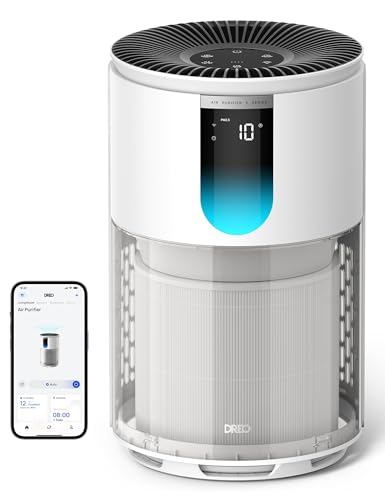
| DREO Smart Air Purifier for Home, Up to 1176 ft² | 158 CFM CADR, with large-area claims | Activated carbon layer plus app scheduling |
| BLUEAIR Blue Pure 311i Max Smart Air Purifier | Designed for medium rooms and broader circulation | HEPASilent particle filtration and sensor control |
| Puraclenz Photon P3000X Air Purifier | Adjustable coverage from 750 to 3,000 square feet | PCO technology and odor reduction claims |
4. Airflow, Fan Speeds, and Contact Time
Odor control depends partly on how often contaminated air passes through the treatment media. Stronger airflow can process a room faster, but the purifier may be louder and the filter may reach saturation sooner.
Look for multiple fan speeds, automatic operation, and a turbo or boost setting when odor events are occasional. DREO provides Auto, Turbo, Sleep, and Normal modes, while Puraclenz includes five speeds and a boost mode for more demanding conditions.
Place the unit where air can circulate freely, leaving space around the intake and exhaust. Running a higher speed shortly after cooking, cleaning, or unpacking furniture can be more useful than leaving a restricted unit on its lowest setting.
5. Ozone Safety and Secondary Emissions
Some air-cleaning technologies can create ozone or other byproducts, which is a serious consideration for bedrooms, nurseries, pets, and people with respiratory sensitivities. A purifier marketed as ozone-free may be preferable when continuous operation is planned.
Check whether the manufacturer clearly identifies ozone testing, certification, or an ozone-free design rather than relying on vague language about advanced purification. Puraclenz specifically describes the Photon P3000X as ozone-free and designed for use around people, pets, and plants.
Do not assume that a device advertised for chemical odors is automatically safe for every situation. Maintain ventilation, follow the manual, and stop using any purifier that produces a new irritating smell or causes discomfort.
6. Sensors, Automatic Modes, and Odor Limitations
Built-in sensors can monitor changes in particulate pollution and automatically adjust the fan. They are useful after cooking or during dusty activities, but a PM2.5 sensor may not detect every VOC or chemical odor.
DREO models provide real-time PM2.5 monitoring, AQI displays, and automatic speed adjustment. BLUEAIR also uses sensors to respond to pollution levels, giving you convenient control even though sensor readings should not be treated as a complete chemical analysis.
Use automatic mode for everyday particle changes, then select a higher manual speed when a known odor source appears. If the smell remains while the particle reading looks normal, investigate ventilation and filter capacity rather than assuming the sensor is malfunctioning.
7. Filter Life, Replacement, and Ongoing Maintenance
A purifier’s long-term value depends on whether replacement filters are accessible and affordable. Odor-heavy environments can consume carbon capacity faster than ordinary dust exposure, even when the filter does not look visibly dirty.
Compare washable pre-filters, filter-life indicators, replacement reminders, and the manufacturer’s maintenance schedule. DREO’s smart model calculates remaining filter life and sends replacement reminders through its app, while Puraclenz uses a washable pre-filter alongside its PCO system.
Vacuum or wash reusable pre-filters only as directed, and let washable components dry completely before reinstalling them. Never extend a saturated carbon filter simply because airflow still feels strong, since odor performance can decline first.
8. Noise, Placement, and Daily Usability
A purifier that remains switched off is not helping, so quiet operation directly affects real-world performance. Bedroom and office users should compare sleep modes, display dimming, fan noise, and the unit’s footprint before purchasing.
DREO includes sleep modes that turn off display lights, and its BLDC motor and airflow design are intended for quieter operation. BLUEAIR lists QuietMark-certified performance and a compact design suited to bedrooms, offices, and living areas.
Place the purifier near the odor pathway without blocking doors, vents, or furniture. A smaller unit beside the source may work better than a larger unit hidden behind a sofa, provided the chosen model has enough airflow for that space.
9. Smart Controls, Scheduling, and Energy Use
Smart controls are not required for odor reduction, but they can make consistent operation easier. Scheduling lets you increase purification during renovation work, nighttime routines, or recurring cooking periods without manually adjusting the machine.
The DREO Smart Air Purifier for Home, Up to 1176 ft² supports Wi-Fi, voice assistants, app control, air-quality reports, and detailed scheduling. The non-smart DREO models may suit shoppers who prefer straightforward controls without another connected appliance.
Energy use usually rises with fan speed and operating hours, so choose a properly sized unit rather than oversizing solely for a larger headline number. An efficient purifier running continuously can be more useful than a powerful model used only occasionally.
10. Technology Fit and Household Safety
Chemical odor control is not one universal task because smells can come from solvents, smoke, mold, plastics, fragrances, or damp materials. Identify the likely source before choosing between carbon-based filtration, particle filtration, PCO technology, or a layered approach.
For smoke and mixed household particles, a high-efficiency filter paired with activated carbon offers a familiar combination. For surface-related concerns and odor sources associated with mold prevention, Puraclenz’s air and surface purification claims provide a distinct alternative.
No purifier should be used as a substitute for removing wet materials, repairing water damage, ventilating solvents, or following product safety instructions. Source control always reduces the pollutant load more effectively than relying on filtration alone.
Why You Should Trust Us
We built this comparison from the supplied product data, published specifications, stated filtration technologies, coverage information, controls, operating modes, and maintenance features. We did not physically test these units, so our recommendations do not claim hands-on laboratory performance.
Our shortlist emphasizes the factors that most influence chemical-odor decisions: gas-focused media, particle filtration, airflow, room suitability, safety statements, sensor capability, and filter maintenance. We also considered how each product fits different household priorities, including quiet bedrooms, smart scheduling, broad coverage, and surface-focused treatment.
Product information and availability can change, which is why the comparison should be revisited whenever specifications, included filters, or manufacturer guidance are updated. We separate published claims from our buying interpretation, allowing you to make a better-informed decision for your own indoor environment.
Final Thoughts
Our best overall choice is the DREO Smart Air Purifier for Home, Up to 1176 ft². It combines a high-efficiency filter, activated carbon layer, strong airflow, PM2.5 monitoring, app scheduling, voice control, and filter-life reminders for a balanced everyday setup.
For value, we recommend the DREO Air Purifier for Home, Up to 1176 ft². Its activated carbon layer, AHAM Verified CADR, multiple modes, and automatic monitoring address common household particles and odors without requiring smart-home features.
The best option for a smaller room is the DREO Air Purifier for Home, HEPA Sleep Mode. Its compact-room focus, activated carbon layer, sleep mode, automatic adjustment, and quiet-oriented design make it practical for bedrooms and home offices.
Choose the Puraclenz Photon P3000X Air Purifier when ozone-free PCO technology, surface treatment claims, mold prevention, and odor reduction are central priorities. The BLUEAIR Blue Pure 311i Max Smart Air Purifier remains appealing for shoppers prioritizing quiet particle filtration, smart monitoring, and a clean modern design.
Before buying, consider pairing this guide with our Home & Living product guides for practical ways to improve comfort throughout your space. The best result comes from matching the technology to the odor source, then maintaining ventilation and replacing filters on schedule.
FAQs About Best Air Purifiers for Chemical Odors
Do air purifiers remove chemical odors completely?
No purifier can guarantee complete removal of every chemical odor, especially when the source continues releasing VOCs. Ventilation, source removal, and appropriate carbon or gas-focused media must work together for the strongest improvement.
Are HEPA filters effective against chemical smells?
HEPA filters primarily target airborne particles rather than gases. A purifier with HEPA or high-efficiency filtration and activated carbon is generally more suitable when both particles and odors are present.
How long should an air purifier run after painting?
Run the purifier continuously according to the manufacturer’s instructions while maintaining strong ventilation. Continue operation after the smell fades, but address the paint source and follow its safety guidance rather than relying on filtration alone.
Can an air purifier help with new furniture smell?
It may reduce some odors when the unit includes meaningful activated carbon or another gas-targeting medium. Keep new furniture ventilated in a suitable area, because a purifier cannot prevent ongoing off-gassing from the materials.
What is the top-rated option among Best Air Purifiers for Chemical Odors in 2026?
The Puraclenz Photon P3000X stands out for its ozone-free PCO technology and stated focus on odors, mold-related contaminants, and exposed surfaces. DREO models may be a better fit when you specifically want conventional high-efficiency filtration with an activated carbon layer.
Does activated carbon wear out faster around strong odors?
Yes, carbon capacity can be consumed more quickly when the purifier is exposed to a heavy or continuous odor source. Replace the filter according to the manual and consider the odor’s persistence, not only its visible dust buildup.
Can air purifiers detect VOCs automatically?
Some specialized devices include VOC sensors, but a PM2.5 sensor generally measures particles rather than every gaseous pollutant. A normal particle reading does not prove that chemical odors or VOCs are absent.
Is ozone safe for removing chemical odors?
Ozone can irritate the respiratory system and should not be treated as a casual household odor solution. Prefer clearly documented ozone-free equipment for occupied rooms, and follow all manufacturer safety instructions.
Where should I place a purifier for the strongest odor reduction?
Place it near the room’s odor pathway while keeping the intake and exhaust unobstructed. Avoid hiding it behind furniture, and use higher airflow when the source is active or the smell is strongest.
Are smart air purifiers worth choosing for odor control?
Smart controls are useful when you want schedules, remote operation, filter reminders, or air-quality history. They do not improve filtration automatically, so prioritize the filter media and airflow before app features.