
Binoculars that transmit light efficiently reveal more texture, color, and movement when daylight fades or subjects enter shade. The right model can make birdwatching, wildlife observation, hiking, and travel noticeably easier on your eyes.
We compared 6 options from Vortex, Nikon, Nocs Provisions and more, focusing on optical coatings, prism construction, objective size, focusing control, weather protection, and practical handling. This guide also explains common mistakes, including choosing excessive magnification or trusting impressive transmission claims without considering stability.
For additional outdoor buying guidance, our international travel luggage guide can help you plan the rest of your field kit.



Buying Guide for Best Light Transmission Binoculars
1. Optical Coatings and Actual Light Transmission
Optical coatings reduce reflections at air-to-glass surfaces, allowing more available light to travel through the binoculars. Fully multi-coated optics generally outperform basic coated designs because every relevant surface receives anti-reflective treatment.
When comparing specifications, look for fully multi-coated lenses rather than vague language such as enhanced optics or premium glass. A transmission percentage can be useful, but consider it alongside color neutrality, edge sharpness, and whether the manufacturer explains how the figure was measured.
As a practical rule, prioritize complete multi-coating before chasing an unusually large magnification number. The Vortex Crossfire HD 10×42 Binoculars and Nocs Provisions models both emphasize multi-coated optics, which directly supports brighter, more consistent viewing.
2. Objective Lens Size and Exit Pupil
The objective lenses are the larger front lenses, and their diameter influences how much light the binoculars can gather. Exit pupil shows how much light reaches your eye, calculated by dividing objective diameter by magnification.
An 8×42 model produces a 5.25mm exit pupil, while a 10×42 model produces 4.2mm. Larger exit pupils can appear brighter in dim conditions, although your eyes may not use the entire beam in strong daylight.
Large objectives often improve low-light performance but add weight and bulk, so match them to your carrying habits. The Nikon Monarch M5 Binoculars use an 8×42 format that balances light gathering, steadiness, and all-day outdoor comfort.
3. Magnification Versus Image Stability
Magnification enlarges distant subjects, but it also enlarges hand movement and makes the view harder to hold steadily. For walking trails or tracking birds, moderate magnification often provides a more usable image than an extreme specification.
Eight-power binoculars are forgiving and typically offer a wider field, while ten-power models reveal more distant detail with additional shake. Twenty-power binoculars can suit long-range landscapes or stationary targets, but they may require support for comfortable observation.
Choose 8x for general wildlife and moving subjects, 10x for open habitats, and higher power when distance matters more than mobility. If you select the Pankoo 20×55 Binoculars for Adults, plan to use a stable rest or tripod whenever possible.
4. Prism Type and Glass Quality
Prisms redirect the image so binoculars remain compact, and their glass quality influences brightness, contrast, and color accuracy. BAK4 prisms are commonly valued for rounder exit pupils and reduced edge darkening compared with lower-grade alternatives.
ED glass addresses a different problem by reducing chromatic aberration, which appears as colored fringes around high-contrast subjects. This matters when you inspect feathers, branches, distant rooftops, or bright skies against dark objects.
Compare prism material, prism coatings, and objective glass together rather than treating one label as decisive. Nikon’s Monarch M5 combines ED glass with dielectric prism coating, creating a strong specification profile for detail-sensitive observation.
5. Field of View and Close-Focus Performance
Field of view describes how much landscape you can see at a set distance, usually expressed in feet at one thousand yards. A wider field helps you locate birds quickly and follow moving wildlife without constantly repositioning the binoculars.
Close-focus distance matters for butterflies, nearby birds, museum displays, and plants along a trail. Compare the stated distance carefully, because a model optimized for distant scanning may feel less versatile at short range.
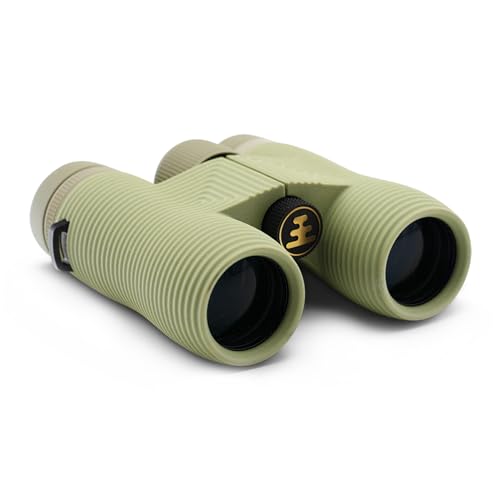
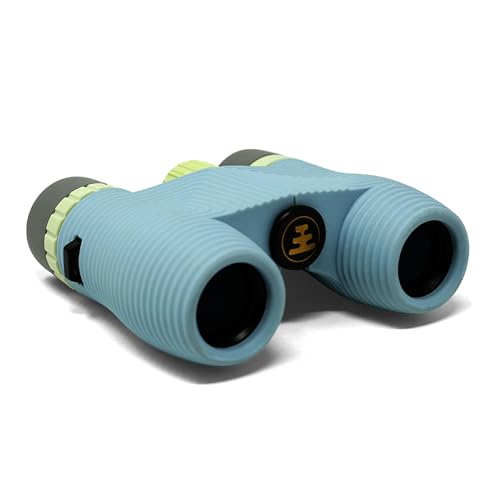
Look for a broad field when tracking motion and a short close-focus distance when studying nearby detail. Nocs Provisions Field Issue Compact 10×32 lists a wide viewing area and focusing from approximately 9.3 feet to infinity.
6. Low-Light Use and Twilight Expectations
Good light transmission improves twilight performance, but no binocular can create detail that the scene does not contain. Atmospheric haze, pupil size, subject contrast, and your ability to hold the view steady all affect perceived brightness.
For dawn or dusk, compare exit pupil, objective diameter, anti-reflective coatings, and focusing precision. A larger objective may help, but a lighter 8×42 binocular can produce better real-world results if you can hold it steadily.
Do not judge low-light suitability from magnification alone, and avoid assuming that a larger lens guarantees sharper detail. Use a model with balanced optics for handheld use, then add a tripod when extended evening viewing is planned.
7. Weather Sealing and Outdoor Durability
Waterproof and fogproof construction protects the optical path when humidity changes or weather becomes unpredictable. O-ring seals and nitrogen purging help prevent water entry and internal condensation that can obscure an otherwise strong image.
Check whether the specification says waterproof, water-resistant, or gives an ingress rating, because those descriptions imply different levels of protection. IPX7 protection is more reassuring for wet field conditions than a general statement about handling light rain.
Rubber armor also matters because it improves grip and helps absorb everyday impacts. The Nikon Monarch M5, Vortex Crossfire HD, and Nocs Provisions options emphasize weather-ready construction, while the Zoom Tube is water-resistant rather than a full-size waterproof binocular.
8. Focus Controls, Eyecups, and Eyeglass Comfort
A smooth central focus wheel lets you react quickly when a subject moves from foreground branches to distant cover. A separate diopter adjustment compensates for differences between your eyes, producing a sharper image after proper setup.
Twist-up eyecups should offer stable positions rather than sliding unexpectedly during use. Eyeglass wearers usually benefit from folding the cups down or selecting an intermediate position that preserves the full field of view.
Before comparing advanced optical claims, confirm that the controls are easy to reach and precise enough for your hands. Nocs models include multi-stop eyecups, while Vortex provides adjustable eyecups and a diopter for flexible viewing.
9. Size, Weight, and Carrying Comfort
Weight affects how long you can hold binoculars without fatigue, particularly during hikes, sporting events, or repeated bird searches. Compact designs travel easily, but smaller objectives may reduce exit pupil and twilight performance.
Compare total weight, body dimensions, strap design, and whether the binoculars fit your hands naturally. A slightly heavier model can still be the better choice if its focus wheel, balance, and grip reduce shaking.
For pocket portability, the Nocs Provisions Standard Issue 10×25 Binoculars are easier to carry than full-size designs. The Nocs Provisions Zoom Tube 8×32 Monocular is even lighter, though one-eye viewing changes depth perception and comfort.
| Model | Format | Optical strengths | Best fit |
|---|---|---|---|
| NIKON Monarch M5 Binoculars | 8×42 | ED glass, dielectric coating, broad view | All-purpose wildlife viewing |
| Nocs Provisions Field Issue Compact 10×32 | 10×32 | Fully coated optics, BAK4 prism, IPX7 | Travel and wet conditions |
| Vortex Crossfire HD 10×42 Binoculars | 10×42 | HD elements, multi-coating, tripod ready | Open-country observation |
| Pankoo 20×55 Binoculars for Adults | 20×55 | Large objectives, BAK4 prism, high power | Long-distance viewing with support |
| Nocs Provisions Standard Issue 10×25 Binoculars | 10×25 | Compact multi-coated optics | Pocketable everyday carry |
| Nocs Provisions Zoom Tube 8×32 Monocular | 8×32 | Fully coated optics, tripod thread | Ultra-light single-eye viewing |
10. Accessories, Warranty, and Long-Term Value
Included caps, straps, cleaning cloths, smartphone compatibility, and tripod threads can determine whether your binoculars are ready immediately. Accessories should support the way you observe rather than merely increase the specification list.
Warranty terms are especially valuable for equipment used outdoors, where accidental knocks and changing weather are unavoidable. Read exclusions carefully, because transferable repair coverage, manufacturing defects, loss, and cosmetic damage may be treated differently.
For adjacent equipment decisions, our handheld outdoor tool guide offers another example of comparing portability, durability, and operating comfort. Apply the same principle here: choose usable performance over impressive but irrelevant extras.
Why You Should Trust Us
We shortlisted these products by comparing published optical specifications, verified feature descriptions, magnification formats, objective sizes, coatings, prism details, weather protection, portability, and intended use.
Our comparison separates optical potential from practical usability, since a large objective or powerful magnification does not automatically create a better handheld view. We also considered how each design serves different priorities, including travel, wildlife, twilight observation, and long-distance scanning.
We do not claim physical testing where the supplied data does not support it. Instead, we present transparent, specification-based guidance and keep the comparison suitable for updates as product information and availability change.
Final Thoughts
Our best overall recommendation is the NIKON Monarch M5 Binoculars, because ED glass, dielectric prism coating, an 8×42 format, and weather sealing address the most important buying criteria together.
For a strong value-oriented balance, consider the Vortex Crossfire HD 10×42 Binoculars. Their multi-coated optics, 10x reach, tripod compatibility, and durable waterproof design suit open-country users who want detail without jumping to extreme magnification.
For compact travel, the Nocs Provisions Field Issue Compact 10×32 is a practical specific-use choice, combining manageable weight, a broad field, fully coated optics, and IPX7 protection.
If portability outweighs binocular depth perception, the Nocs Provisions Zoom Tube 8×32 Monocular is convenient for hiking. The Pankoo 20×55 Binoculars for Adults make more sense for distant stationary targets when you can provide stable support.
Travelers who want a pocketable option can also examine the Nocs Provisions Standard Issue 10×25 Binoculars. For broader preparation advice, compare our international travel luggage recommendations before packing outdoor optics.
FAQs
What are the Best Light Transmission Binoculars in 2026?
The Nikon Monarch M5 stands out for its ED glass, dielectric prism coating, 8×42 balance, and outdoor sealing. Your best choice may differ if compact size, extreme reach, or one-handed portability matters more.
Are binoculars with larger objective lenses always brighter?
Larger objectives can gather more light, but brightness also depends on magnification, coatings, prism quality, and your ability to hold the image steady. A well-designed 42mm model may outperform a heavier larger model during handheld use.
What does fully multi-coated mean on binoculars?
Fully multi-coated means the relevant air-to-glass surfaces receive multiple anti-reflective layers. This reduces reflections and usually improves brightness, contrast, and color consistency throughout the view.
Is 8x or 10x magnification better for birdwatching?
Eight-power binoculars are easier to stabilize and generally provide a wider field for finding moving birds. Ten-power models reveal more distant detail, especially in open habitats, but require steadier hands.
Can high-power binoculars be used without a tripod?
You can use them briefly without support, but hand movement becomes obvious as magnification rises. A tripod, railing, or stable viewing surface makes high-power binoculars more comfortable and improves usable detail.
Are compact binoculars suitable for dusk observation?
Compact binoculars can work in moderate light, but their smaller objectives often produce a narrower exit pupil. They are convenient for travel, while larger balanced formats usually suit extended dawn or dusk viewing better.
What is the advantage of ED glass?
ED glass reduces color fringing caused by chromatic aberration, especially around bright subjects and high-contrast edges. It can improve perceived sharpness and natural color, although coatings and overall optical alignment remain important.
How should eyeglass wearers choose binoculars?
Look for adjustable twist-up eyecups with multiple positions and sufficient eye relief. During setup, fold or lower the cups as needed, then adjust the diopter so both eyes see a crisp image.
What weather protection should outdoor binoculars have?
For regular outdoor use, waterproof housing, O-ring seals, and nitrogen purging provide useful protection against rain and internal fogging. A stated ingress rating, such as IPX7, gives more specific information than a general weather-resistant claim.
Are monoculars a good alternative to binoculars?
A monocular is lighter, smaller, and convenient when one-handed operation matters. Binoculars generally provide more comfortable viewing and better depth perception because both eyes share the image.