Comfortable Seating for Best Chairs for Quilting
Quilting asks you to concentrate on precise stitching while your body stays in one position for extended periods. The right chair can reduce pressure on your lower back, keep your arms aligned with the machine, and make everyday sewing more enjoyable.
Our guide to Best Chairs for Quilting in September 2026 compares 5 options from brands including Reliable, ArrowSewing, Pink Power and more. We focus on practical details such as seat height, lumbar support, storage, base design, upholstery, and the relationship between your chair and work surface.
Many shoppers choose a sewing chair by appearance alone, then discover that the seat is too tall, the casters move unpredictably, or the backrest encourages poor posture. The comparison below helps you avoid those mistakes while choosing a chair suited to your quilting space, machine, and working habits.
If you are furnishing a broader home workspace, our guide to Furniture & Comfort products offers additional ideas for creating a more supportive room.



How to Choose Best Chairs for Quilting
1. Seat Height and Worktable Alignment
Seat height determines whether your shoulders relax, your elbows reach the machine naturally, and your feet remain stable near the pedal. A chair that is too low can force you to lean forward, while excessive height may leave your feet dangling.
Measure the distance from the floor to the top of your sewing chair, then compare it with the height of your machine table. Hydraulic models such as the Arrow Sewing H7013B Adjustable Height Hydraulic adjust from 18 to 22 inches, while the Pink Power Sewing Chair with Wheels and Adjustable ranges from 19 to 23 inches.
As a practical starting point, sit with your thighs roughly level and your feet fully supported. Leave enough room for your knees beneath the table, and remember that a thick cushion may compress slightly after several minutes of use.
2. Lumbar Support and Backrest Position
Quilting often involves looking downward, so your upper body naturally wants to round forward. Proper lumbar support cannot eliminate that movement, but it can help maintain a more neutral lower-back position during long piecing or machine-quilting sessions.
Look for a backrest that supports the curve above your hips without pushing your torso too far forward. The Arrow Sewing H7013B Adjustable Height Hydraulic includes targeted lumbar support, while the Pink Power Sewing Chair with Wheels and Adjustable offers an adjustable backrest designed to match different sewing tables.
Adjust the backrest so its lower section contacts your back comfortably rather than stopping at your waist. If you frequently alternate between sewing and cutting, choose support that allows upright posture without restricting natural movement.
3. Seat Cushion Comfort and Pressure Distribution
A comfortable cushion spreads your weight across the seat instead of concentrating pressure beneath the tailbone or thighs. This becomes especially important when a quilting project takes several hours and you cannot easily change positions.
Consider cushion thickness, resilient padding, seat width, and the front edge shape together. The Pink Power Sewing Chair with Wheels and Adjustable uses a high-resilience padded cushion, while the Ultrahome Wood Sewing Chair with Storage emphasizes an ergonomic design for extended crafting work.
Do not automatically choose the softest chair available, because excessive sinking can make it harder to maintain stable pedal control. A moderately firm cushion with a rounded front edge usually balances support, circulation, and movement better.
4. Mobility, Casters, and Swivel Control
Wheels and a swivel base are useful when you move between a sewing machine, cutting surface, storage cabinet, and pressing station. Mobility reduces repeated standing, although a chair that rolls too freely can become frustrating during detailed stitching.
Compare the caster design, base stability, and floor compatibility rather than counting wheels alone. Several reviewed models use a five-star 360-degree swivel base, and the Arrow Sewing H7013B Adjustable Height Hydraulic specifies heavy-duty casters intended to roll smoothly without marking many floors.
For hard flooring, check whether the casters glide without vibration or sudden stops. On thick rugs, wheels may catch, so a stable base or a protective chair mat can provide better control than maximum mobility.
5. Storage for Notions and Quilting Tools
Built-in storage keeps thread, rulers, clips, bobbins, and small tools close to the seat. It can also reduce interruptions, because you do not need to stand repeatedly whenever a basic notion is missing from the table.
Compare the storage opening, usable depth, and access direction instead of assuming every under-seat compartment has the same capacity. The Arrow Sewing H7013B Adjustable Height Hydraulic, Pink Power Sewing Chair with Wheels and Adjustable, Lessmore Adjustable Height Sewing and Crafting, and Ultrahome Wood Sewing Chair with Storage all emphasize storage or organization features.
Use the compartment for lightweight supplies rather than dense objects that could affect balance. A simple rule is to store items you use every session there, while keeping sharp tools protected in a separate container.
6. Base Stability and Pedal Control
A quilting chair must remain steady while your foot operates the pedal and your hands guide fabric. An unstable base can create small unwanted movements that affect stitching accuracy and make your legs work harder.
Five-star bases generally provide a broad foundation, while footers can offer additional resistance when rolling is undesirable. The Reliable Ergonomic Task Chair, Sewing Chair specifically highlights non-slip footers and three adjustable features, but its product information notes that rolling casters are not included.
Think about whether you sew with one foot planted continuously or shift position often. If pedal control is your priority, fixed support may be preferable; if you regularly reach supplies, a lockable or controlled rolling base may be more practical.
7. Seat Shape and Armless Design
Armless chairs allow your elbows to move freely while you guide fabric, adjust a machine, or turn toward a nearby cutting surface. They also slide beneath many sewing tables more easily than office chairs with wide armrests.
Check whether the seat gives your hips enough room without creating excess depth behind your knees. A compact sewing chair may fit a small craft room better, while a wider seat can feel more comfortable for larger users or heavier layers.
Before buying, compare the chair footprint with the clearance around your machine. Leave enough turning space for your knees and feet, because a chair that technically fits can still feel restrictive when the room is crowded.
8. Upholstery, Durability, and Cleaning
Quilting rooms collect loose threads, lint, fabric fibers, and occasional adhesive or beverage spills. Durable upholstery helps the chair remain presentable, while a surface that wipes clean can save time during frequent projects.
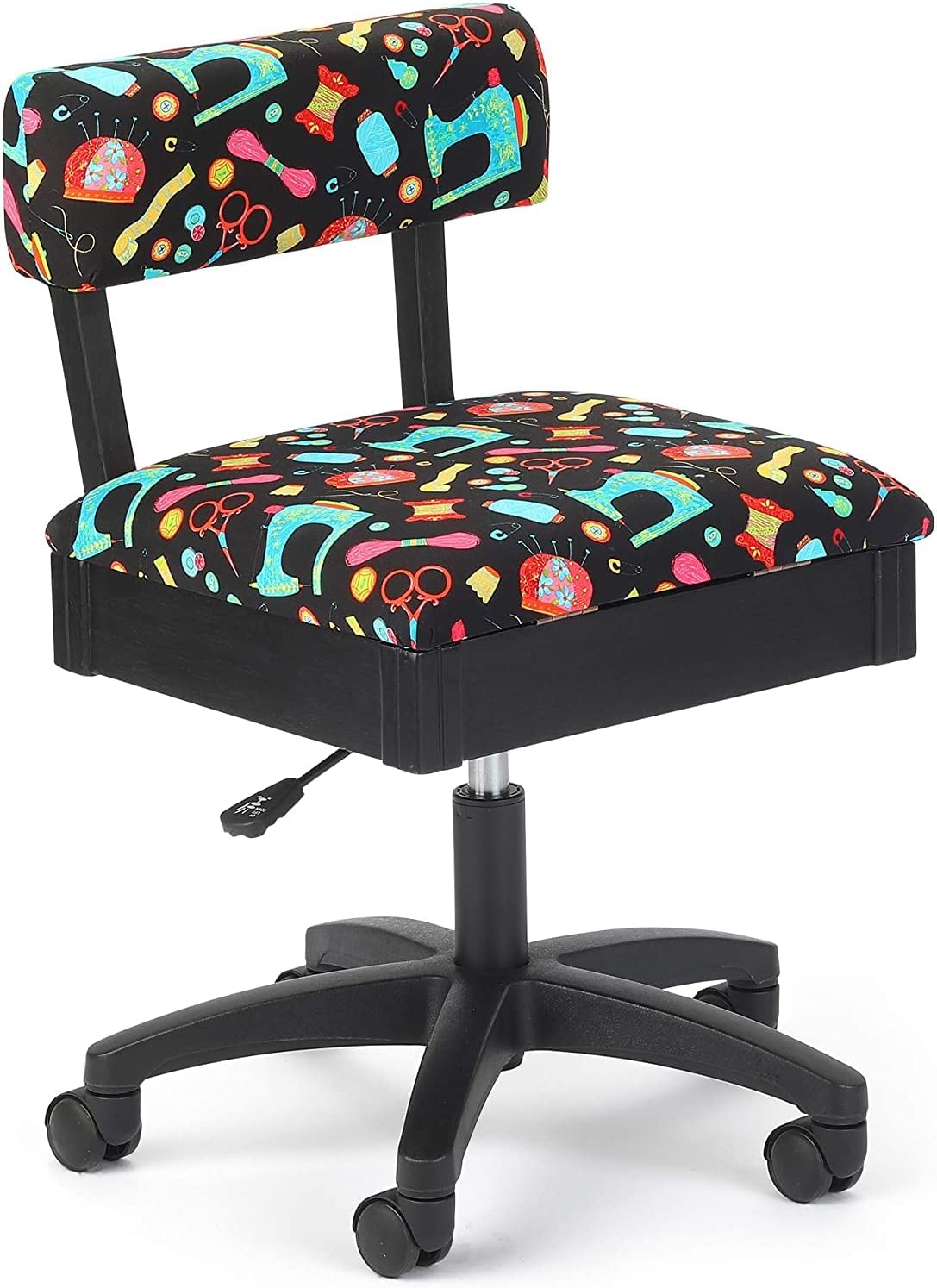
Compare fabric construction, padding retention, stitching, and the manufacturer’s warranty rather than judging durability by color. The Arrow Sewing H7013B Adjustable Height Hydraulic lists durable upholstery fabric and a one-year warranty, while the Reliable chair emphasizes Canadian manufacturing and craftsmanship.
Patterned upholstery can disguise small fibers and coordinate with a creative room, but neutral fabric may integrate more easily into shared spaces. Keep a small vacuum or lint brush nearby, and avoid using harsh cleaners unless the care instructions approve them.
9. Weight Capacity and Personal Fit
Weight capacity is a safety specification, not merely a comfort detail. Staying below the stated limit helps preserve the hydraulic lift, cushion shape, casters, and base stability over time.
Among these products, the Pink Power Sewing Chair with Wheels and Adjustable lists a 300-pound capacity. Use that figure as a ceiling rather than a target, and account for occasional movement, leaning, or items placed beneath the seat.
Fit also depends on torso length, hip width, and leg length, so a high rating cannot guarantee comfort. If possible, compare seat dimensions with a chair you already use comfortably, then check the return policy before committing.
10. Warranty, Support, and Long-Term Value
A sewing chair receives repeated loading, rolling, swiveling, and height adjustments, making after-sales support important. A clear warranty can provide useful protection if a hydraulic mechanism, caster, or structural component develops a problem.
Compare warranty duration, covered parts, exclusions, and the process for obtaining assistance. The Arrow Sewing H7013B Adjustable Height Hydraulic lists a one-year warranty, while Ultrahome and Lessmore emphasize responsive customer support in their product information.
Long-term value means more than the initial purchase amount, because a chair that supports posture and lasts through multiple projects may cost less per year. For broader home-comfort decisions, you can also browse the Home & Living category.
| Comparison point | What to check | Why it matters |
|---|---|---|
| Height range | Adjustability relative to your table | Supports neutral arms and stable feet |
| Back support | Lumbar shape and adjustment | Helps reduce forward-slouching fatigue |
| Mobility | Casters, swivel, and floor behavior | Makes movement easier without sacrificing control |
| Storage | Access and usable compartment space | Keeps notions within reach |
| Capacity | Published weight limit and fit | Supports safe, durable everyday use |
Why You Should Trust Us
We built this comparison from the supplied product specifications, listed features, stated dimensions, brand information, and current availability details. We did not claim hands-on testing, so our recommendations distinguish clearly between published capabilities and practical buying interpretation.
Products were shortlisted because they address meaningful quilting needs, including adjustable height, lumbar support, storage, padded seating, swivel movement, stable footers, or durable upholstery. We considered how those features affect different sewing setups rather than treating decorative patterns or brand recognition as decisive.
Our comparison can be refreshed as product specifications, availability, and market positioning change. Before ordering, verify the current listing, measurements, warranty terms, and compatibility with your table, floor, and preferred sewing posture.
Final Thoughts on Best Chairs for Quilting
Our best overall recommendation is the Arrow Sewing H7013B Adjustable Height Hydraulic because it combines targeted lumbar support, useful height adjustment, under-seat storage, a swivel base, and heavy-duty casters. It is a balanced choice for quilters who want one chair to handle repeated machine work and general crafting.
For value-focused shoppers, the Lessmore Adjustable Height Sewing and Crafting brings together adjustable height, wheels, back support, and hidden storage. Its feature mix suits a dedicated craft room where convenience and organization matter as much as basic seating comfort.
For users who prioritize an adjustable backrest and mobile support, consider the Pink Power Sewing Chair with Wheels and Adjustable. Its stated 300-pound capacity, padded cushion, backrest adjustment, storage, and five-star swivel base make it especially useful for multitasking between quilting stations.
The Reliable Ergonomic Task Chair, Sewing Chair is worth considering when fixed stability and adjustable ergonomic support are more important than rolling mobility. Meanwhile, the Ultrahome Wood Sewing Chair with Storage offers a practical option for crafters who want storage and a chair designed for sewing-room use.
For more comfort-oriented shopping ideas beyond sewing furniture, explore our review of rollator walkers with seats. The same principles of support, stability, adjustability, and daily usability can help you evaluate many home products.
Best Chairs for Quilting FAQs
What makes a chair suitable for quilting?
A suitable quilting chair supports your lower back, places you at the correct height for the machine, and keeps your feet stable near the pedal. A padded, armless design with controlled movement can also make fabric handling easier.
Should a quilting chair have wheels?
Wheels are useful when you move between a sewing machine and nearby supplies or work surfaces. However, fixed footers may be better if you need maximum stability during precise stitching.
Are office chairs suitable for quilting?
Some office chairs can work, but wide armrests, excessive recline, or a deep seat may interfere with machine access. Sewing chairs are usually designed with a more compact footprint and movement pattern.
How high should a quilting chair be?
Your chair should place your elbows comfortably near the machine surface while keeping your feet supported. Measure your table and compare its height with the chair’s adjustment range before purchasing.
Is lumbar support important for machine quilting?
Yes, because machine quilting often encourages prolonged forward attention and rounded shoulders. Lumbar support helps maintain a more neutral sitting position, although regular posture changes remain important.
Do quilting chairs need armrests?
Most quilters prefer armless chairs because their elbows need room to guide fabric and reach machine controls. Armrests can be comfortable for breaks, but they may prevent the chair from sliding close enough to the table.
What should be stored under a sewing chair?
Use built-in storage for lightweight, frequently used items such as bobbins, clips, thread, seam rippers, and small rulers. Keep sharp tools secured so they cannot shift beneath the seat or damage the compartment.
How do I stop a sewing chair from rolling?
Choose a model with non-slip footers or use a suitable chair mat that reduces unwanted movement. You can also position the chair on a surface where the casters remain stable without catching.
What is the top-rated option among Best Chairs for Quilting in 2026?
The Arrow Sewing H7013B Adjustable Height Hydraulic stands out for its combination of lumbar support, height adjustment, storage, swivel movement, and stated warranty. The right choice still depends on your table height, floor type, and preference for rolling mobility.
Are storage compartments worth having?
Storage is worthwhile if you frequently keep notions near the machine and want to reduce trips across the room. It is less important if your workspace already has drawers within easy reach.