Countertop ovens have moved well beyond simple toast controls, giving busy households precise cooking programs, convection airflow, and larger meal capacity.
We compared 6 models for toast quality, usable space, controls, versatility, and everyday convenience across the available Breville, Nuwave, and CHEF iQ options.
This guide is especially useful if you want one appliance for breakfast and dinner, but do not want to sacrifice predictable browning or countertop space.
Before choosing, consider whether you need four slices or six, basic controls or app monitoring, and a compact footprint or family-sized capacity. Our related guide to air fryer toaster ovens offers another useful comparison point.



Buying Guide for Best Smart Ovens for Toasting
1. Toasting Consistency and Browning Control
The most important feature is still dependable toast, because advanced cooking modes cannot compensate for pale centers or burned edges.
Compare the number of toast settings, slice capacity, rack position options, and whether the control panel allows separate darkness adjustments.
For a household serving toast at different preferences, choose an oven with clear browning increments and enough room to avoid overlapping slices.
Remember that bread thickness, moisture, and starting temperature change results, so a model with repeatable controls is more valuable than one with impressive program counts.
2. Interior Capacity and Countertop Footprint
Capacity determines whether the oven handles only breakfast or replaces several functions normally assigned to a full-size range.
Small interiors suit apartments and limited counters, while larger cavities can accommodate a family meal, a substantial pizza, or more toast simultaneously.
Measure the available counter depth, width, and overhead clearance before ordering, including space needed to open the door safely.
A useful rule is to prioritize internal dimensions over advertised quart capacity, since rack positions and heating-element placement affect usable cooking space.
| Model | Toast capacity | Notable capacity detail | Best fit |
|---|---|---|---|
| Breville BOV900BSS Smart Oven Air Fryer Pro | Large household use | Large multi-purpose cavity | Broadest cooking flexibility |
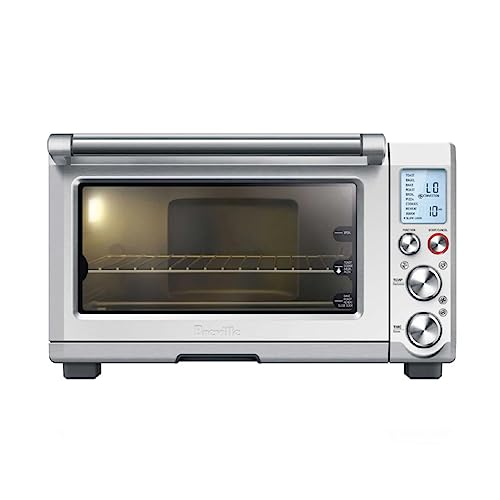
| Breville BOV845BSS Smart Oven Pro | Up to 6 slices | 13-inch pizza and larger dishes | Family kitchens |
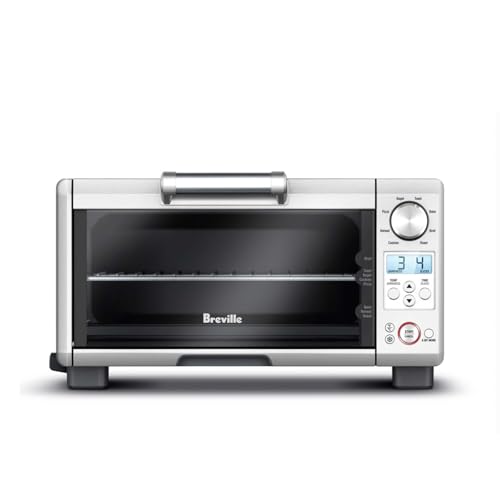
| Breville BOV450XL Mini Smart Oven | Up to 4 slices | Compact 11-inch pizza space | Small counters |
| Nuwave Bravo 30 QT Smart Air Fryer Toaster Oven | Large batch use | 30-quart class interior | Air frying and meal preparation |
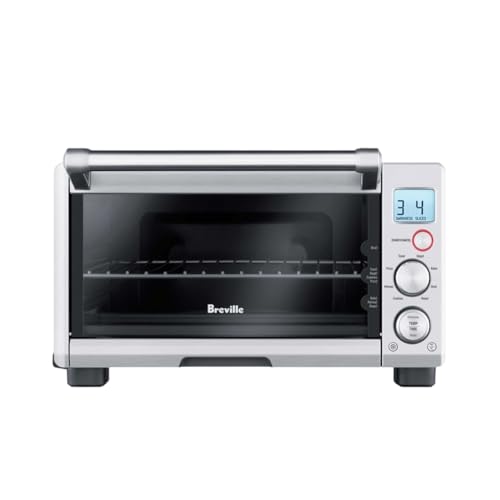
| Breville BOV650XL Compact Smart Oven | Up to 4 slices | Compact 12-inch pizza space | Everyday compact cooking |
| CHEF iQ MiniOven Smart Toaster Oven Air Fryer | Up to 6 slices | 25-quart class interior | Connected family cooking |
3. Heating Technology and Temperature Accuracy
Heating technology affects how evenly toast browns and how confidently you can follow recipes for baking, roasting, or reheating.
Breville models use Element iQ systems that distribute power among independent quartz elements, while Nuwave emphasizes continuous temperature management.
When comparing specifications, look for adjustable temperature ranges, small setting increments, preheat information, and explanations of how heat is regulated.
For delicate toast, lower temperatures and shorter cycles are easier to control; for crisp foods, accurate heat and airflow become more important.
4. Cooking Functions Beyond Toast
The right smart oven should earn its counter space by handling more than bread, especially when kitchen space is limited.
Common programs include bagel, bake, broil, roast, pizza, cookies, reheat, and air fry, but not every oven includes the same combination.
List the meals you prepare most often, then confirm those functions rather than choosing based solely on the largest advertised number.
A compact oven with eight useful modes may serve you better than a larger appliance whose extra programs rarely leave the menu.
5. Convection and Airflow Performance
Convection uses a fan to move hot air around food, helping shorten cooking times and improve browning across the cavity.
Air frying requires stronger circulation and an appropriate basket or rack arrangement, while toast depends on balanced radiant heat from above and below.
Check whether the fan operates automatically or only in selected modes, and examine how many rack positions support different food sizes.
Use lower temperatures when adapting conventional recipes for convection, then check food early because moving air can accelerate surface browning.
6. Controls, Display, and Smart Features
Smart controls should make cooking simpler, not force you through complicated menus for a basic slice of toast.
Compare physical dials, touchscreen controls, display readability, automatic countdowns, interior lighting, alerts, and the ease of changing time or temperature.
The Nuwave model supports on-the-fly adjustments and numerous presets, while the CHEF iQ model connects with an app for remote monitoring.
Choose app connectivity only if you will use it; otherwise, fast direct controls and a visible display may provide the better daily experience.
7. Temperature Probe and Cooking Feedback
Temperature feedback matters most when you roast meat, prepare thicker foods, or want automatic stopping at a selected internal temperature.
The Nuwave Bravo includes an integrated digital temperature probe, and the CHEF iQ MiniOven is compatible with the iQ Sense thermometer.
Compare whether the probe is included, optional, wired, app-connected, or limited to particular cooking modes before treating it as a deciding feature.
For toast alone, a probe is unnecessary; for frequent roasting, it can reduce guesswork and prevent repeated door opening.
8. Cleaning, Accessories, and Daily Maintenance
Crumbs, grease, and melted cheese accumulate quickly in toaster ovens, so cleaning design directly affects whether the appliance remains pleasant to use.
Look for removable crumb trays, nonstick cavity coatings, accessible rack positions, washable baskets, and included baking or broiling pans.
Before buying, confirm which parts are dishwasher-safe and whether replacement trays or racks are available through the manufacturer.
Empty the crumb tray frequently, wipe spills after cooling, and avoid covering ventilation openings because trapped residue can create smoke.
9. Safety, Door Design, and Placement
A countertop oven produces substantial heat, making safe placement and predictable door operation essential in compact kitchens.
Check ventilation guidance, cool-touch areas, automatic shutoff, interior lighting, door clearance, and whether the controls prevent accidental starts.
Soft-close construction, such as the feature described for the CHEF iQ MiniOven, can be helpful where children or busy traffic surround the counter.
Keep the oven on a stable heat-resistant surface and maintain the manufacturer’s required clearance from walls, cabinets, and combustible objects.
10. Warranty, Reliability, and Long-Term Fit
Reliability is difficult to judge from specifications alone, so warranty terms and service access deserve careful attention before purchase.
Compare warranty length, covered components, registration requirements, return policies, and the availability of replacement trays or heating elements.
A model with more electronics may offer better automation but also creates more components that could require support over time.
For additional kitchen buying context, our guide to choosing the right household appliance accessories illustrates why maintenance planning matters.
Why You Should Trust Us
We evaluated the supplied product specifications, stated cooking functions, capacity details, control systems, included features, and manufacturer-described technologies.
Products were shortlisted across compact, family-sized, air-frying, and connected categories so different kitchens could find a reasonable match.
Our comparison does not claim physical testing or independent laboratory measurements, because those results were not provided for this review.
We focus instead on verifiable distinctions, practical trade-offs, and transparent interpretation of listed specifications, with content reviewed for changing product information.
Final Thoughts
For the strongest all-around balance, we recommend Breville BOV845BSS Smart Oven Pro. Its Element iQ system, convection setting, ten cooking functions, interior light, and room for larger dishes make it a versatile household centerpiece.
For compact value, consider Breville BOV650XL Compact Smart Oven. It combines eight practical functions, a four-slice capacity, a nonstick cavity, and a smaller footprint for kitchens that need daily flexibility without a large appliance.
For the smallest counters, Breville BOV450XL Mini Smart Oven is the more focused choice. Its compact interior, fast preheat, Element iQ controls, and toast, bagel, pizza, and reheat programs suit individuals or smaller households.
For connected cooking, CHEF iQ MiniOven Smart Toaster Oven Air Fryer stands apart with app monitoring, touchscreen controls, eleven functions, and compatibility with a smart thermometer.
If precise temperature monitoring and extensive presets matter most, Nuwave Bravo 30 QT Smart Air Fryer Toaster Oven deserves attention for its probe, adjustable heaters, and broad cooking flexibility.
Readers comparing adjacent countertop appliances can also review our air fryer and toaster oven category guide before making a final decision.
FAQs About Best Smart Ovens for Toasting
Are smart ovens good for making toast every day?
Yes, smart ovens can handle daily toast while also supporting bagels, reheating, baking, and roasting. Choose a model with clear browning controls and enough capacity for your household routine.
Can a smart oven replace a regular toaster?
It can replace a regular toaster if you are comfortable with a larger appliance and a slightly different workflow. The benefit is gaining multiple cooking functions without keeping separate countertop equipment.
How many slices should a toaster oven accommodate?
Four slices generally suit one or two people, while six slices are more convenient for families. Also check slice dimensions, because thick artisan bread may reduce practical capacity.
Do smart ovens toast both sides evenly?
Evenness depends on element placement, rack position, bread spacing, and the selected setting. Independent heating elements and consistent controls can improve repeatability, but food placement still matters.
What is the top-rated option among Best Smart Ovens for Toasting in 2026?
The Breville BOV845BSS Smart Oven Pro is the strongest general recommendation because it balances toast capacity, convection cooking, useful programs, and straightforward controls. The ideal choice still depends on your counter space and cooking habits.
Are convection settings useful for toast?
Convection can help food brown and crisp more quickly, though traditional toast settings may provide simpler control for bread. Start with the manufacturer’s recommendation and adjust gradually for your preferred finish.
Can these ovens cook frozen pizza?
Several reviewed models include pizza functions and interiors designed for pizza-sized cookware. Confirm the stated internal dimensions, then leave enough clearance for airflow and safe door operation.
What should I do if toast burns before the timer ends?
Lower the browning setting, move the rack position, and check whether convection is active. Bread thickness and residual heat can also affect results, so record the setting that works for your usual loaf.
Are app-connected ovens worth choosing?
App connectivity is useful when you want remote monitoring, guided presets, or thermometer feedback. It is less valuable if you mainly toast bread and prefer direct physical controls.
How often should a smart toaster oven be cleaned?
Empty the crumb tray frequently and wipe visible spills after the oven cools. Deeper cleaning should follow the manufacturer’s instructions, especially around heating elements, fans, and coated interior surfaces.