Repairing SMD components, removing connectors, and reworking circuit boards becomes far more predictable when your station delivers controlled heat and adjustable airflow. The right setup can replace several separate tools while giving you better control over delicate electronics.
We compared 10 Best Hot Air Soldering Stations in September 2026, including compact hot-air units and combination stations from YIHUA, LRT, WEP, Beaiguna, and SYIZYEN. This guide focuses on specifications that change real repair results, including temperature stability, airflow control, standby behavior, accessories, and electrical compatibility.
Specifications can be confusing because wattage, temperature range, and airflow numbers do not tell the whole story. If you also work on general household projects, our guide to home and living equipment offers another useful starting point for choosing practical tools.





1. Temperature Range and Control
Temperature range determines whether a station can handle routine solder melting, lead-free work, heat-shrink tubing, and demanding rework jobs. A broad range is useful, but stable control near your chosen setting matters more than an impressive maximum.
Compare the separate ranges for the soldering iron and hot-air gun when reviewing a two-in-one model. Several stations in this comparison reach roughly 896°F, while some hot-air models extend to 932°F, giving additional headroom for stubborn solder and larger thermal loads.
As a practical starting point, use the lowest temperature that melts your solder efficiently, then increase gradually if the joint or component demands it. Excessive heat can lift PCB pads, damage plastic connectors, or overheat nearby parts even when airflow is set correctly.
2. PID Stability and Heat Recovery
PID control continuously monitors temperature and adjusts power when the heating element loses heat during contact or airflow changes. This reduces temperature swings, which is especially important when working with small pads, sensitive components, or lead-free solder.
Look for explicit PID stabilization, rapid temperature compensation, or digital calibration features rather than assuming every digital display provides equal accuracy. YIHUA, WEP, and Beaiguna models in this group describe monitoring or calibration functions designed to improve repeatability.
Do not judge recovery speed solely by the advertised wattage. A well-designed heating core, sensor placement, blower, and control program work together, so a lower-power station may still perform more consistently on small electronic assemblies.
3. Airflow Adjustment and Nozzle Control
Airflow determines how broadly heat spreads across the board and how quickly a component reaches rework temperature. Too much air can move tiny parts or heat neighboring components, while too little airflow may prolong heating and create uneven results.
Compare whether airflow uses a dedicated knob, a digital setting, or a limited preset system. The WEP 8858-V provides straightforward knob adjustment, while other stations advertise airflow ranges or maximum delivery around 120 liters per minute.
Choose a smaller nozzle for concentrated work and a wider nozzle for larger components or uniform heating. Keep the nozzle moving gently instead of holding it stationary, and begin with moderate airflow before increasing it for larger thermal masses.
4. Two-in-One Versus Hot-Air-Only Design
A two-in-one station combines a conventional soldering iron with a hot-air tool, which saves bench space and lets you switch techniques quickly. This arrangement suits repairers who remove components with hot air and then clean, tin, or resolder pads with an iron.
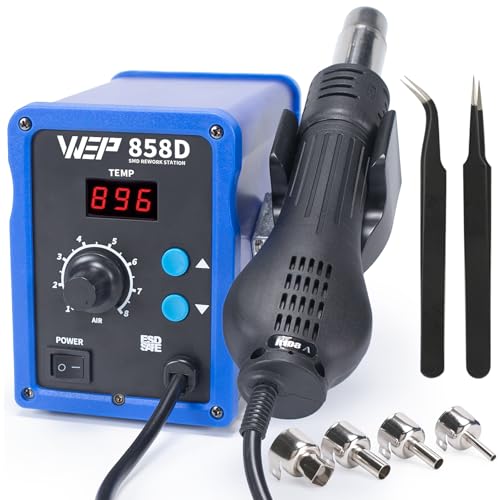
A hot-air-only unit can be the better choice when you already own a dependable soldering iron or need a smaller dedicated rework tool. The LRT 858D, WEP 858D, WEP 8858-V, and YIHUA 959D focus on hot-air operation rather than duplicating equipment you already have.
Before selecting a combination model, check whether both tools can operate independently and whether each has its own controls or display. Independent switches make troubleshooting easier and prevent accidental activation of the unused heating system.
5. Standby, Sleep, and Fail-Safe Protection
Automatic standby functions cool the hot-air handle when it returns to its holder, reducing unnecessary heat and extending heating-element life. Sleep modes for soldering irons can also reduce tip oxidation when you pause between joints.
Fail-safe protection is equally important because a stopped blower can leave a heating element dangerously hot. Models such as the YIHUA 8786D I and YIHUA 959D describe protection that detects abnormal airflow or handle conditions and reduces power automatically.
Check exactly what triggers standby and whether the feature can be adjusted or disabled. A useful rule is to favor automatic cooling for shared workbenches, frequent pauses, and beginners who may forget to return the handle promptly.
6. Heating Power and Electrical Compatibility
Wattage indicates available heating power, but it should be interpreted alongside temperature recovery, airflow, and the size of your typical components. Higher power can shorten warm-up time, though it also demands careful technique around heat-sensitive plastics and thin circuit boards.
Several products here use 700W hot-air systems, while combination models allocate power across separate iron and hot-air circuits. A brushless fan, efficient heating core, and stable control system can be more meaningful than comparing wattage alone.
Verify the voltage and plug before ordering, especially if equipment will be used outside the United States. Many listed stations are designed for 110 to 127V operation and should never be connected directly to a 220V outlet.
7. Nozzles, Tips, and Included Accessories
Accessories affect how quickly you can begin working and whether the station suits different component sizes. Commonly useful additions include several hot-air nozzles, soldering tips, tweezers, a desoldering pump, solder wire, and a tip-cleaning system.
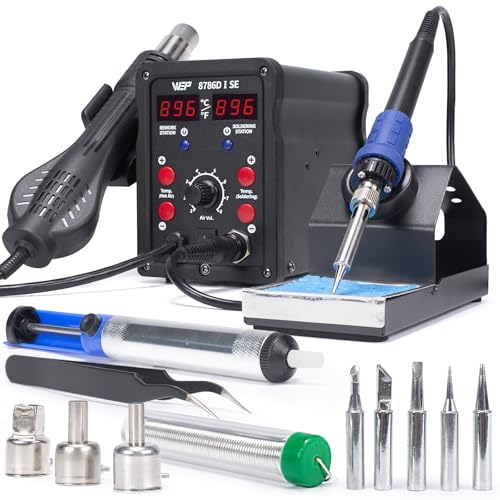
Compare accessory quality and compatibility rather than counting every item equally. WEP 882D, WEP 8786D-I SE, and YIHUA combination stations include sets intended for varied rework tasks, while dedicated units generally concentrate their kits around nozzles and handling tools.
For small ICs and connectors, use a nozzle that covers the target without bathing the entire board in hot air. Keep spare tips available for the soldering iron, because worn or oxidized tips transfer heat poorly and make accurate work unnecessarily difficult.
8. Ergonomics, Noise, and Bench Footprint
Bench comfort becomes important during repeated repairs, when a heavy handle, awkward holder, or noisy blower can slow you down. Compact stations are easier to store, but an overly small control panel may be harder to read or adjust while holding a board.
Look for an integrated holder, a protected nozzle area, a cable with enough reach, and controls that remain visible from your normal working position. The LRT 858D lists a brushless fan and noise below 45 decibels, while the WEP 8858-V emphasizes compact storage.
Measure the available bench space before buying a two-in-one station, including room for the handle and board fixture. Leave clear space around the nozzle and avoid placing cords where they can contact hot surfaces or snag your wrist.
| Feature | What to compare | Why it matters |
|---|---|---|
| Temperature | Separate iron and hot-air ranges | Matches solder and component requirements |
| Airflow | Adjustable control and nozzle options | Controls heating area and component movement |
| Control system | PID, calibration, and display behavior | Improves repeatability across repairs |
| Safety | Standby, sleep, and fail-safe functions | Reduces wear and overheating risks |
| Format | Dedicated hot air or two-in-one | Determines versatility and bench-space needs |
9. Warranty, Support, and Replacement Parts
Rework stations contain heating elements, blowers, sensors, and cables that eventually experience wear. Manufacturer support and replacement-part availability can therefore matter more than a small difference in initial specifications.
Review the stated technical-support period, regional coverage, and whether replacement nozzles, handles, heating elements, or soldering tips are easy to identify. YIHUA and WEP describe United States support options for several products in this comparison.
Save the manual and record the model number after purchase, since compatible parts may differ between visually similar stations. If repair work is business-critical, prioritize documented support over a larger accessory bundle.
Why You Should Trust Us
We shortlisted these stations by comparing manufacturer specifications, stated temperature ranges, airflow controls, safety functions, included accessories, electrical requirements, and intended repair applications. We also considered how each design fits different users, from occasional DIY work to repeated PCB rework.
Our comparison separates verified product features from assumptions about real-world performance. We do not claim to have physically tested these stations, and we avoid treating advertised wattage or maximum temperature as a substitute for measured laboratory results.
Because listings and specifications can change, the comparison is designed around features readers can verify before ordering. We recommend checking the current product page, voltage requirements, accessories, and support terms, just as shoppers should do with other equipment in the Uncategorized buying guides.
Final Thoughts
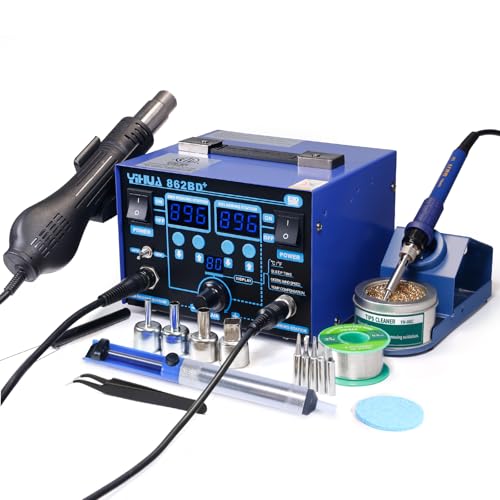
Our best overall recommendation is YIHUA 862BD+ SMD ESD Safe 2 in 1 Soldering Iron. Its combination format, PID temperature control, separate displays, sleep function, ESD-safe design, and broad accessory set make it a strong choice for varied electronics repair.
For value-focused buyers, Beaiguna 2 in 1 Hot Air Rework Soldering Iron offers useful two-tool flexibility, independent controls, auto-sleep, calibration, and a compact kit. Its single hot-air temperature display is worth noting, but the feature set remains practical for home repair and hobby projects.
For dedicated hot-air work, YIHUA 959D-Digital Hot Air Rework Station stands out with three preset channels, a maximum stabilized temperature of 932°F, high airflow output, and an in-holder standby system.
If you need another compact option, the WEP 8858-V Hot Air Rework Station Kit with emphasizes simple airflow adjustment, integrated storage, PID control, and included tweezers. For broader household equipment research, you can also browse our review of electric bikes for adults.
FAQs
What is the top-rated option among Best Hot Air Soldering Stations in 2026?
The YIHUA 862BD+ offers the most complete combination of hot-air rework and conventional soldering features in this comparison. Its PID control, ESD-safe design, multiple displays, safety functions, and included tools suit varied repair tasks.
Do I need a two-in-one soldering station?
A two-in-one station is useful if you regularly remove components with hot air and finish joints with a soldering iron. If you already own a good iron, a dedicated hot-air station may save space and avoid paying for duplicate equipment.
What temperature should I use for hot-air rework?
The correct setting depends on solder type, board construction, component size, and airflow. Start conservatively, keep the nozzle moving, and increase temperature gradually instead of beginning at the station’s maximum.
Is higher wattage always better for electronics repair?
Higher wattage can improve warm-up and recovery, but it does not guarantee better temperature stability or safer rework. Heating control, airflow consistency, nozzle selection, and operator technique determine whether that power is useful.
Can hot-air stations remove USB-C ports?
Many listed stations are intended for SMD work and applications such as USB-C port replacement, but successful removal requires suitable airflow, preheating, flux, and careful shielding. Protect nearby plastic parts and avoid overheating board pads.
What does PID mean on a rework station?
PID refers to a control method that monitors temperature and adjusts heating power to maintain the selected setting. It can reduce temperature fluctuation during airflow changes or when the nozzle approaches a thermally demanding joint.
Are these stations safe for lead-free solder?
Several products explicitly describe lead-free compatibility or include lead-free solder wire. Lead-free solder generally requires careful temperature control, good ventilation, and a clean tip because it often needs more heat than traditional solder.
Why are multiple hot-air nozzles useful?
Nozzle size changes how concentrated the heat becomes and how widely airflow reaches the board. Smaller nozzles suit focused component work, while larger options can heat bigger packages more evenly.
Can I use a 110V station on a 220V outlet?
Do not connect a 110 to 127V station directly to a 220V outlet. Confirm the electrical requirements and use only an appropriate, properly rated conversion solution when permitted by the manufacturer.
How should I maintain a hot-air rework station?
Keep nozzles clear, avoid blocking the air intake, return the handle to its holder after use, and allow automatic cooling to finish. Replace damaged heating elements, worn cables, or loose tips promptly rather than continuing with unreliable equipment.